
Understanding the Core Distinction
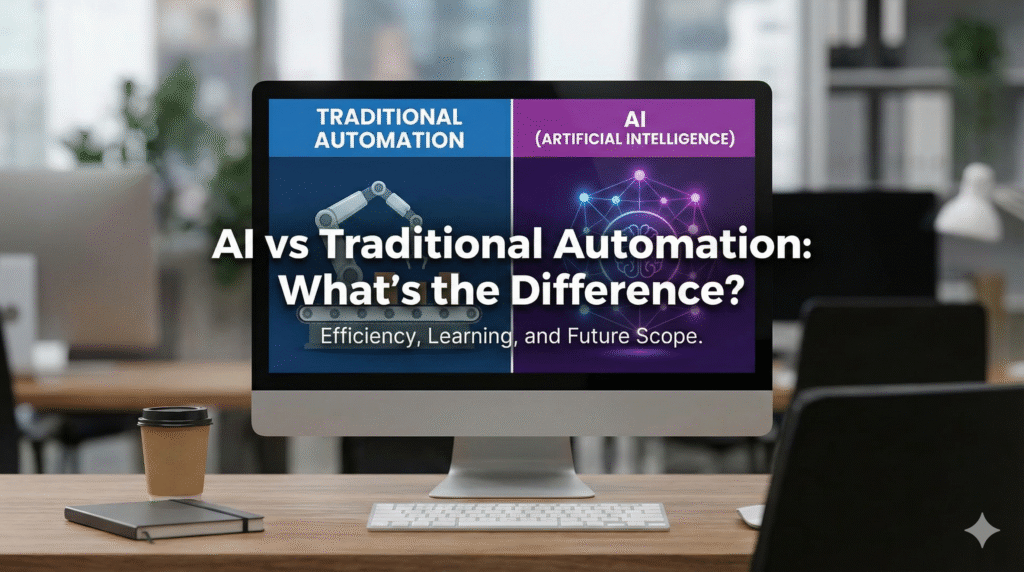
AI (Artificial Intelligence) learns from data and adapts to new situations, making intelligent decisions without explicit programming. Traditional automation follows predetermined rules to execute repetitive tasks. While artificial intelligence mimics human cognitive functions like learning and problem-solving, traditional automation simply executes fixed instructions—representing fundamentally different approaches to workplace efficiency and digital transformation.
What is Traditional Automation?
Traditional automation has been the backbone of industrial and business processes for decades. It operates on a simple principle: if-then logic. These systems execute predefined rules and workflows without deviation. Think of an assembly line robot that performs the same welding task repeatedly, or email filters that move messages to folders based on sender addresses.
Traditional automation excels at:
- Repetitive, rule-based tasks: Data entry, file transfers, and scheduled backups follow consistent patterns that machines can replicate perfectly.
- Predictable workflows: Invoice processing systems that route documents through approval chains operate on fixed business rules.
- High-volume operations: Manufacturing equipment that stamps thousands of identical parts maintains speed and precision through programmed instructions.
The limitations become apparent when variability enters the equation. If a situation arises that wasn’t explicitly programmed, traditional automation fails. It cannot adapt, learn, or make judgment calls. Every possible scenario must be anticipated and coded in advance.
What is AI and How Does It Differ?
Artificial intelligence represents a paradigm shift in how machines interact with information. Unlike traditional automation, AI systems learn from experience, recognize patterns in complex data, and make decisions in ambiguous situations. They don’t just follow instructions—they understand context.
AI technologies encompass several capabilities:
- Machine learning: Algorithms that improve performance through exposure to data, identifying patterns humans might miss.
- Natural language processing: Understanding human language in all its nuanced complexity, from sentiment to intent.
- Computer vision: Interpreting visual information from the world, recognizing objects, faces, and anomalies.
- Predictive analytics: Forecasting future outcomes based on historical patterns and real-time data streams.
The fundamental difference lies in adaptability. Where traditional automation asks “What rule should I follow?” AI asks “What’s the best decision based on everything I’ve learned?” This cognitive capability transforms AI from a tool that executes into one that thinks.
Key Differences Between AI and Traditional Automation
Flexibility and Adaptability
Traditional automation requires reprogramming for every change. Modify a business process, and developers must update the code. Artificial intelligence adapts organically. An AI customer service chatbot learns from each interaction, improving responses without manual updates. This self-improvement capability makes AI invaluable in dynamic environments where conditions constantly evolve.
Decision-Making Capabilities
Traditional automation makes binary decisions based on exact criteria. An automated system might flag invoices over $10,000 for review—nothing more, nothing less. AI evaluates context, considers multiple variables simultaneously, and makes nuanced judgments. It might flag an unusual $5,000 invoice from a new vendor based on spending patterns, payment history, and risk indicators that traditional systems would miss entirely.
Handling Complexity and Uncertainty
Traditional automation thrives in controlled environments with clear parameters. AI flourishes where ambiguity reigns. Consider fraud detection: rule-based systems catch known fraud patterns but fail against novel schemes. AI identifies suspicious behavior by analyzing subtle anomalies across millions of transactions, adapting as fraudsters change tactics.
Data Processing and Analysis
Both approaches process data, but differently. Traditional automation executes data transformations—moving information from spreadsheets to databases, reformatting files, generating standard reports. Artificial intelligence extracts meaning from data. It discovers hidden correlations, predicts customer churn, personalizes recommendations, and generates insights that inform strategic decisions.
Implementation and Maintenance
Traditional automation typically requires less upfront investment but demands ongoing manual updates. Every process change necessitates code modifications. AI implementations require significant initial investment in data infrastructure, model training, and expertise. However, once deployed, AI systems self-optimize, reducing long-term maintenance overhead while delivering increasing value as they learn.
Real-World Applications: Where Each Excels
Traditional Automation Success Stories
Manufacturing has perfected traditional automation. Robotic assembly lines produce cars, electronics, and consumer goods with remarkable consistency. Scheduled backup systems protect data reliably. Email autoresponders handle out-of-office notifications flawlessly. These applications share common traits: repetitive nature, clear rules, and minimal variability.
Financial services use traditional automation for routine transactions—ATM withdrawals, automatic bill payments, and standard loan calculations follow predictable formulas that don’t require intelligence, just precision.
AI Transforming Industries
Artificial intelligence revolutionizes areas requiring judgment and adaptation. In healthcare, AI analyzes medical images, detecting cancers that human radiologists might overlook. The system learns from millions of scans, recognizing subtle patterns indicating early-stage disease.
Retail giants deploy AI for demand forecasting, analyzing weather patterns, social trends, competitor pricing, and historical sales to predict inventory needs. This goes far beyond simple rule-based reordering systems.
Customer experience has been transformed by AI-powered personalization. Streaming services don’t just apply genre filters—they understand individual preferences, viewing habits, and contextual factors to recommend content with uncanny accuracy.
Can AI and Traditional Automation Work Together?
The most powerful solutions combine both approaches strategically. AI handles complex decision-making while traditional automation executes the resulting actions efficiently. Consider an intelligent document processing system: AI extracts information from invoices with varying formats, interprets the data contextually, and flags anomalies. Traditional automation then routes approved invoices through payment workflows.
This hybrid approach leverages each technology’s strengths. Traditional automation provides the reliable, cost-effective execution of defined processes. Artificial intelligence adds the cognitive layer that handles variability, learns from outcomes, and optimizes decisions over time.
Organizations implementing this combination report significant advantages: the efficiency gains of automation coupled with the adaptability and intelligence of AI. The key lies in identifying which tasks require genuine intelligence versus those needing reliable execution.
Choosing the Right Approach for Your Business
The decision between AI and traditional automation depends on several factors:
Opt for traditional automation when tasks are highly repetitive with minimal variation, business rules are stable and well-defined, the environment is controlled and predictable, and budget constraints favor simpler solutions.
Invest in AI when processes involve unstructured data like documents or images, decision-making requires analyzing multiple contextual factors, you need systems that improve over time without constant reprogramming, and competitive advantage comes from personalization or predictive capabilities.
Many organizations start with traditional automation for immediate efficiency gains, then gradually introduce AI where complexity demands it. This phased approach manages risk while building organizational capability in both domains.
The Future: Intelligent Automation
The boundary between AI and traditional automation continues blurring. Modern platforms integrate both seamlessly, creating “intelligent automation” ecosystems. These systems use artificial intelligence for perception, learning, and decision-making, while employing traditional automation for reliable task execution.
As AI technology matures and becomes more accessible, the question shifts from “AI or automation?” to “How much intelligence does this process need?” The future belongs to organizations that strategically deploy both technologies, creating adaptive systems that combine machine efficiency with human-like judgment.
Conclusion
AI and traditional automation serve different purposes in the digital enterprise. Traditional automation excels at executing defined processes with speed and consistency, making it ideal for repetitive, rule-based work. Artificial intelligence brings cognitive capabilities—learning, adapting, and making complex decisions in uncertain environments.
Understanding these differences enables smarter technology investments. Rather than viewing them as competing alternatives, forward-thinking organizations recognize them as complementary tools. Traditional automation provides the operational foundation, while AI delivers the intelligence layer that drives innovation and competitive differentiation.
The question isn’t which technology to choose, but how to blend both strategically to transform your business processes from merely efficient to genuinely intelligent.