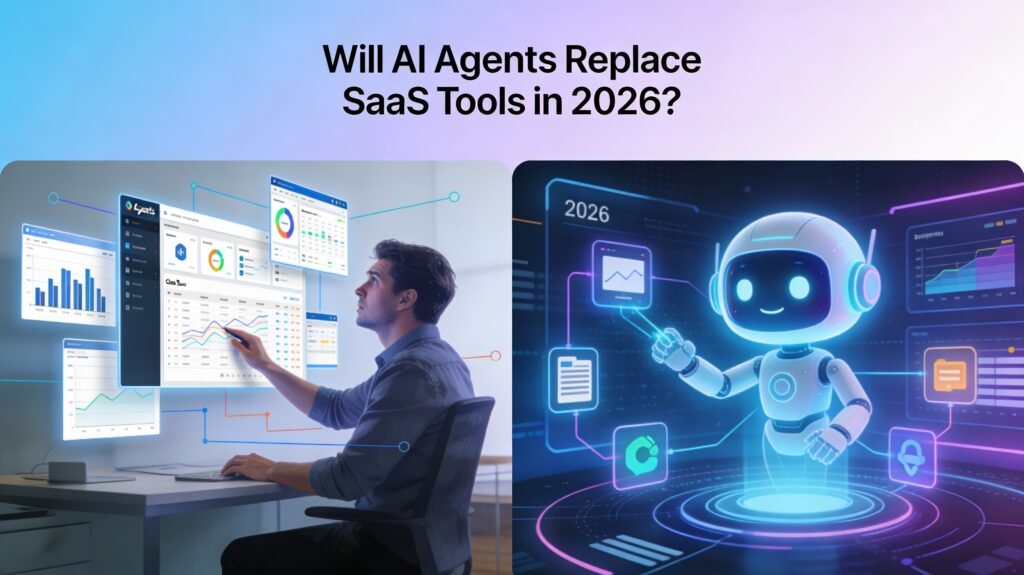
AI Agents are autonomous software systems powered by artificial intelligence that can perform tasks, make decisions, and adapt to user needs without constant human intervention. While AI Agents are rapidly evolving and integrating into SaaS Tools, complete replacement is unlikely by 2026. Instead, we’re witnessing a transformation where AI Agents enhance and augment traditional software solutions.
The Rise of AI Agents in Enterprise Software
The software industry stands at a pivotal moment. AI Agents have moved from theoretical concepts to practical applications that businesses deploy daily. These intelligent systems can automate workflows, analyze data, generate content, and even interact with customers in remarkably human-like ways.
Traditional SaaS Tools have dominated the enterprise landscape for over two decades. Companies rely on specialized software for customer relationship management, project management, marketing automation, and countless other functions. Each tool typically serves a specific purpose, requiring users to navigate between multiple platforms throughout their workday.
AI Agents promise a different approach. Rather than offering static features that users must learn and operate, these agents understand natural language commands, learn from user behavior, and execute complex tasks across multiple systems. The question isn’t whether this technology is impressive—it clearly is—but whether it will completely displace the SaaS ecosystem within the next two years.
Why Complete Replacement Is Unlikely by 2026
Several factors suggest that AI Agents won’t entirely replace SaaS Tools in the immediate future, though they will significantly transform them.
Infrastructure and Integration Complexity
Most enterprises have invested millions in their current SaaS infrastructure. These tools are deeply embedded in business processes, connected through complex integration networks, and supported by trained staff. Replacing this ecosystem wholesale would require not just new technology but complete organizational restructuring. Such transformations typically take five to ten years in large organizations, not two.
Regulatory and Compliance Requirements
Industries like healthcare, finance, and legal services operate under strict regulatory frameworks. SaaS Tools in these sectors have spent years achieving compliance certifications and building audit trails. While AI Agents can theoretically handle compliance, the regulatory approval process moves slowly. Organizations won’t abandon certified solutions for emerging technology without proven compliance track records.
The Learning Curve and Trust Gap
Despite their sophistication, AI Agents still make mistakes. They can misinterpret instructions, generate incorrect information, or fail to understand nuanced business contexts. Many organizations remain cautious about delegating critical decisions to artificial intelligence without human oversight. This trust gap will narrow over time but not disappear entirely by 2026.
Economic Realities
The SaaS industry represents hundreds of billions in annual revenue. Major players like Salesforce, Microsoft, Adobe, and ServiceNow aren’t sitting idle. These companies are actively integrating AI Agents into their existing platforms, creating hybrid solutions that combine the reliability of traditional software with the intelligence of autonomous agents.
The Transformation: AI Agents as Enhancers

Rather than replacement, we’re seeing convergence. AI Agents are becoming features within SaaS Tools, not competitors to them.
Intelligent Automation Layer
Modern SaaS platforms are adding AI Agents as an automation layer that sits above traditional features. Users might tell an agent, “Schedule a meeting with everyone on the marketing team next week,” and the agent handles the complexity of checking calendars, sending invites, and managing responses—all within the existing scheduling tool.
Enhanced Decision Support
AI Agents excel at analyzing vast amounts of data and presenting actionable insights. SaaS Tools for business intelligence and analytics are incorporating these capabilities, allowing users to ask questions in plain English and receive sophisticated analyses without knowing SQL or building complex dashboards.
Personalized User Experiences
One area where AI Agents truly shine is personalization. They can learn individual user preferences and adapt interfaces accordingly. A project management tool enhanced with AI Agents might automatically prioritize tasks based on your work patterns, suggest optimal team assignments, or predict potential bottlenecks before they occur.
What 2026 Will Actually Look Like
By 2026, expect a hybrid landscape where AI Agents and SaaS Tools coexist and complement each other.
Conversational Interfaces Everywhere
Most SaaS platforms will offer conversational interfaces powered by AI Agents. Instead of clicking through menus, users will increasingly interact with software through natural language. However, traditional interfaces won’t disappear—they’ll remain available for tasks requiring precision or verification.
Agent Marketplaces
SaaS providers will likely develop ecosystems where users can deploy specialized AI Agents for specific tasks. Imagine a Salesforce marketplace where you can install an AI Agent specifically trained for lead qualification in your industry, or a project management tool offering agents specialized in different methodologies like Agile or Waterfall.
Reduced but Not Eliminated Tool Sprawl
AI Agents will help reduce the number of separate tools companies need by enabling better integration and workflow automation across platforms. However, specialized SaaS Tools will persist for functions requiring deep expertise, regulatory compliance, or industry-specific capabilities.
The Long-Term Trajectory
While 2026 won’t see AI Agents completely replacing SaaS Tools, the trajectory is clear. Over the next decade, the distinction between “agent” and “tool” will blur significantly.
Successful SaaS companies will be those that embrace AI Agents as a core component of their offering rather than viewing them as threats. The companies that fail to adapt risk obsolescence, but the adaptation itself extends the life of the SaaS model rather than ending it.
For businesses making technology decisions today, the strategy shouldn’t be choosing between AI Agents and SaaS Tools. Instead, focus on selecting SaaS platforms with strong AI integration roadmaps and the flexibility to evolve with this rapidly changing landscape.
Conclusion
AI Agents represent a fundamental shift in how we interact with software, but they won’t replace SaaS Tools by 2026. The more likely scenario is a transformed SaaS ecosystem where artificial intelligence makes existing tools more powerful, intuitive, and autonomous. The future isn’t about choosing between AI Agents and traditional software—it’s about leveraging both to create more efficient, intelligent, and adaptive business systems. Organizations that understand this nuanced reality will be best positioned to capitalize on the AI revolution while maintaining the stability and reliability their operations demand.