What Is an AI Skills Roadmap for Beginners?
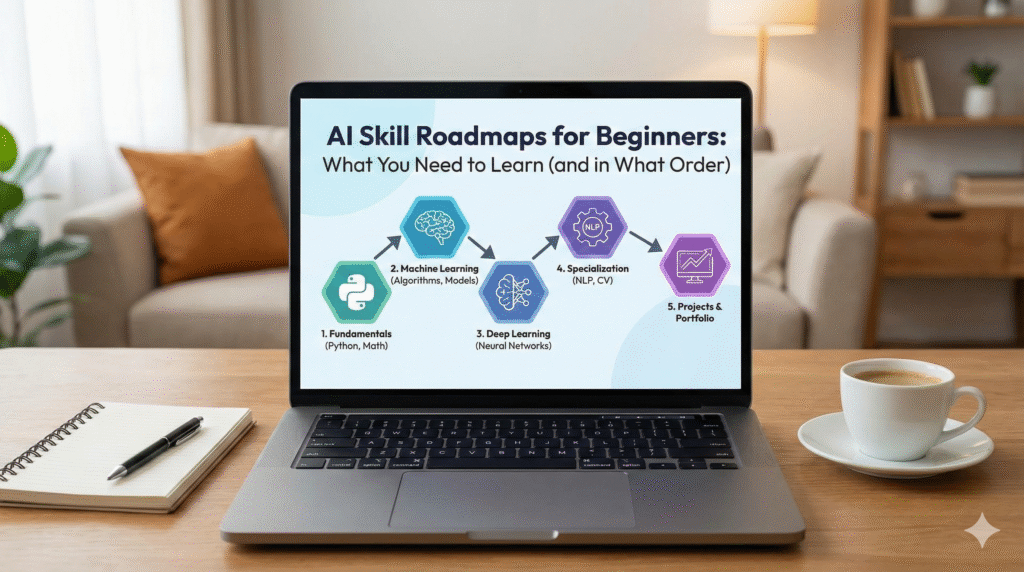
An AI skill roadmap for beginners is a structured, step-by-step guide that outlines the essential knowledge, tools, and competencies needed to build a foundation in artificial intelligence. This beginner AI skills pathway helps newcomers navigate the complex AI landscape by organizing learning objectives in a logical sequence, from foundational mathematics and programming to advanced machine learning techniques and real-world project implementation.
Artificial intelligence is transforming every industry, from healthcare to finance, entertainment to education. If you’re eager to join this revolution but feel overwhelmed by where to start, you’re not alone. The field of AI encompasses numerous disciplines, including mathematics, computer science, statistics, and domain-specific knowledge. Without a clear AI learning road map, beginners often waste time jumping between disconnected tutorials or tackling advanced concepts before mastering the basics.
This comprehensive guide provides a practical AI skills roadmap for beginners, breaking down exactly what you need to learn and in what order. Whether you’re a complete newcomer or someone with basic programming knowledge, this roadmap will help you build a solid foundation and progress systematically toward AI proficiency.
Stage 1: Build Your Foundation (Months 1-3)
Master Python Programming
Python is the lingua franca of AI and machine learning. Before diving into AI-specific concepts, you need to become comfortable with Python fundamentals. Focus on variables, data types, control structures, functions, and object-oriented programming. Don’t aim for perfection—functional competency is enough to move forward.
Key resources: Start with interactive platforms like Codecademy or DataCamp, which offer hands-on Python courses tailored for data science and AI applications.
Strengthen Your Mathematics
AI relies heavily on three mathematical pillars: linear algebra, calculus, and probability/statistics. You don’t need a PhD-level understanding, but you should grasp core concepts. Linear algebra helps you understand how data is represented and transformed. Calculus explains how machine learning algorithms optimize and improve. Statistics enables you to interpret results and validate models.
Practical approach: Learn these concepts in the context of AI applications rather than abstract theory. Khan Academy and 3Blue1Brown’s YouTube channel offer excellent visual explanations that connect mathematical concepts to real-world AI uses.
Understand Data Manipulation
AI is fundamentally about learning from data. Learning how to learn AI step by step requires mastering data manipulation libraries like NumPy and Pandas. These tools allow you to clean, transform, and analyze datasets—skills you’ll use in every AI project.
Practice tip: Find small datasets online (try Kaggle’s beginner datasets) and practice loading, exploring, and visualizing them. This hands-on experience is invaluable.
Stage 2: Learn Machine Learning Fundamentals (Months 4-6)
Grasp Core ML Concepts
Once your foundation is solid, it’s time to explore machine learning concepts. Start with supervised learning (classification and regression), then move to unsupervised learning (clustering and dimensionality reduction). Understand the difference between training and testing data, the concept of overfitting, and basic evaluation metrics.
Key distinction: Machine learning is a subset of AI skill that focuses on algorithms that learn from data. Understanding this relationship helps you see where you are on your AI learning road map.
Master Scikit-learn
Scikit-learn is Python’s most popular machine learning library for beginners. It provides simple, consistent interfaces for dozens of algorithms. Work through tutorials that cover linear regression, logistic regression, decision trees, random forests, and k-means clustering.
Project idea: Build a simple predictive model, such as predicting house prices or classifying emails as spam. These beginner AI skills projects cement your understanding and give you portfolio pieces.
Learn Model Evaluation
Understanding how to assess model performance is crucial. Learn about metrics like accuracy, precision, recall, F1-score, and ROC curves. Understand cross-validation and why it matters for creating models that generalize well to new data.
Stage 3: Dive Into Deep Learning (Months 7-9)
Understand Neural Networks
Deep learning, powered by neural networks, represents the cutting edge of AI. Start with the fundamentals: what neurons are, how layers connect, activation functions, and backpropagation (the algorithm that enables learning). You don’t need to implement these from scratch initially—focus on conceptual understanding.
Learn TensorFlow or PyTorch
These frameworks make building neural networks accessible. TensorFlow (with Keras) is more beginner-friendly, while PyTorch offers greater flexibility and is preferred in research. Choose one and stick with it for now—you can learn the other later. Work through tutorials on building simple neural networks for image classification or text analysis.
Explore Computer Vision and NLP
Apply your deep learning knowledge to two major AI domains. Computer vision involves teaching computers to understand images and videos. Natural language processing (NLP) enables machines to understand and generate human language. Start with pre-trained models and transfer learning before building custom architectures.
Practical projects: Create an image classifier that recognizes different types of objects, or build a sentiment analysis tool that determines whether movie reviews are positive or negative.
Stage 4: Specialize and Build Real Projects (Months 10-12)
Choose Your Focus Area
AI is vast, and specialization makes you more marketable. Consider these paths based on your interests: computer vision (autonomous vehicles, medical imaging), NLP (chatbots, translation), reinforcement learning (robotics, game AI), or AI ethics and responsible AI. Your choice should align with your career goals and genuine curiosity.
Master Advanced Tools and Techniques
Depending on your specialization, learn domain-specific tools. For NLP, explore Hugging Face Transformers and large language models. For computer vision, dive deeper into convolutional neural networks and object detection frameworks like YOLO. Learn about model deployment, MLOps practices, and how to scale AI solutions.
Build a Portfolio
Theory and tutorials only take you so far. Employers and collaborators want to see what you’ve built. Create 3-5 substantial projects that demonstrate your beginner AI skill journey. Document your process, share your code on GitHub, and write blog posts explaining your approach and results.
Portfolio suggestions: A recommendation system, an object detection application, a chatbot with personality, or a predictive analytics dashboard.
Essential Success Tips for Your AI Journey
Stay consistent over intense. Learning how to learn AI skill step by step requires daily practice rather than marathon weekend sessions. Thirty minutes daily beats six hours on Sunday.
Join communities. AI is collaborative. Participate in Kaggle competitions, join Discord servers, attend local meetups, and engage on platforms like Reddit’s r/MachineLearning. Learning alongside others accelerates your progress and keeps you motivated.
Don’t get stuck in tutorial hell. After completing a tutorial, immediately modify the project with your own ideas. This active experimentation cements learning far better than passive consumption.
Embrace failure. Your models will perform poorly. Your code will break. This is normal and necessary. Each failure teaches you something new and brings you closer to proficiency.
Conclusion
Following this AI skill roadmap for beginners provides a structured path through the sometimes-overwhelming world of artificial intelligence. Remember that this timeline is flexible—some may progress faster, others may need more time on certain topics, and that’s perfectly fine. The key is consistent, purposeful learning and regular hands-on practice.
AI is not just for mathematical geniuses or computer science PhDs. With dedication, curiosity, and the right learning sequence, anyone can develop these powerful skills. Start with Stage 1 today, trust the process, and in one year, you’ll be amazed at what you can build and understand.
Your AI journey begins with a single step. Take it now.