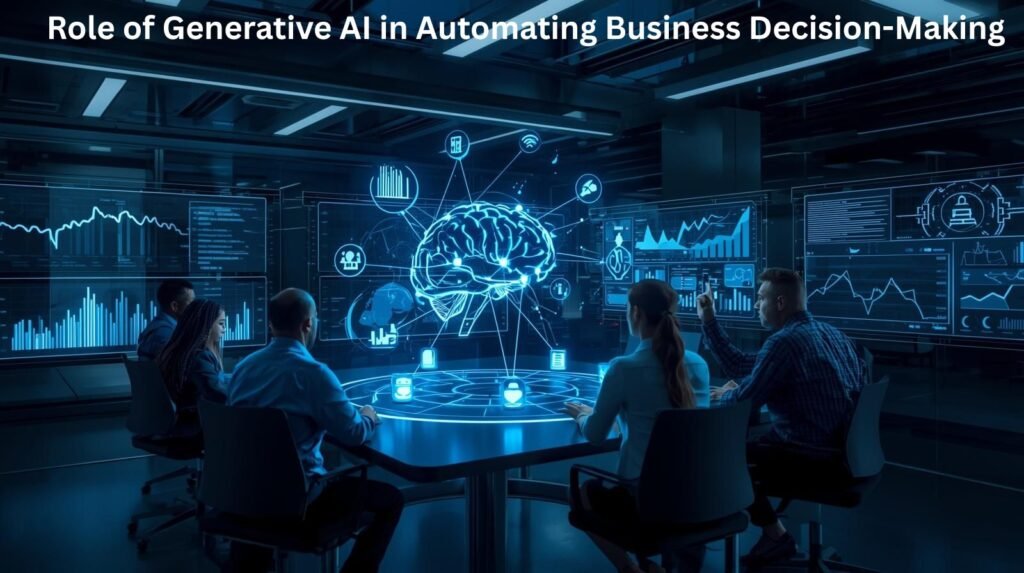
Generative AI is revolutionizing how organizations approach business decision-making by automating complex analytical processes, generating actionable insights, and enabling real-time strategic responses. This transformative technology leverages advanced machine learning models to process vast datasets, identify patterns, and produce recommendations that traditionally required extensive human analysis. As companies face increasingly complex market dynamics, Generative AI emerges as a critical tool for maintaining competitive advantage through faster, more accurate, and data-informed decisions.
Understanding Generative AI in Business Contexts
Generative AI refers to artificial intelligence systems capable of creating new content, insights, and solutions based on learned patterns from existing data. Unlike traditional analytical tools that simply report on historical information, Generative AI automation actively produces forecasts, scenarios, and strategic recommendations. This capability fundamentally changes how businesses approach everything from market analysis to resource allocation.
In the context of business decision-making, Generative AI operates by synthesizing information from multiple sources—including market trends, customer behavior, operational metrics, and external economic indicators—to generate comprehensive insights. The technology can simulate countless scenarios, predict outcomes, and recommend optimal courses of action in minutes, a process that would take human analysts days or weeks to complete.
Key Applications of AI-Driven Decision Making
Strategic Planning and Market Analysis
AI business intelligence platforms powered by generative models transform strategic planning by providing executives with predictive analytics and scenario modeling. These systems analyze competitor movements, market trends, and consumer sentiment to generate strategic recommendations. Companies can explore multiple strategic pathways simultaneously, understanding potential outcomes before committing resources.
The technology excels at identifying emerging opportunities and threats that might escape human observation. By processing news feeds, social media trends, regulatory changes, and economic indicators, generative systems alert decision-makers to shifts in the business environment that require strategic responses.
Financial Forecasting and Risk Management
AI-powered data analysis revolutionizes financial planning by generating accurate forecasts based on historical performance, market conditions, and external variables. Generative models can simulate thousands of financial scenarios, helping CFOs understand potential risks and opportunities across different market conditions.
These systems automate variance analysis, identifying discrepancies between projected and actual performance while generating explanations for these differences. This capability allows finance teams to focus on strategic responses rather than spending time on manual data reconciliation and analysis.
Operational Optimization
Generative AI automation streamlines operational decision-making by optimizing supply chains, workforce allocation, and resource management. The technology generates recommendations for inventory levels, production schedules, and logistics routing based on demand forecasts, capacity constraints, and cost considerations.
Manufacturing facilities use generative models to predict equipment maintenance needs, preventing costly breakdowns while optimizing maintenance schedules. The AI analyzes sensor data, maintenance histories, and operational patterns to generate predictive maintenance recommendations that balance equipment reliability with operational costs.
Customer Experience and Personalization
AI-driven decision making enhances customer experience by generating personalized product recommendations, pricing strategies, and communication approaches. Generative systems analyze individual customer behaviors, preferences, and purchase histories to create tailored experiences that increase engagement and conversion rates.
Marketing teams leverage these capabilities to generate campaign strategies, content variations, and targeting recommendations. The AI tests multiple approaches simultaneously, learning from results and continuously refining its recommendations to maximize campaign effectiveness.
Benefits of Automating Business Decisions with Generative AI
Speed and Efficiency
Traditional decision-making processes often involve lengthy data gathering, analysis, and stakeholder consultation. Generative AI compresses these timelines dramatically by automating data processing and generating insights instantly. Executives can receive comprehensive analysis and recommendations within hours rather than weeks, enabling faster responses to market opportunities and competitive threats.
This speed advantage proves particularly valuable in dynamic industries where delays in decision-making result in lost opportunities or competitive disadvantages. Companies using generative AI for decision support consistently outpace competitors in time-to-market for new products and responsiveness to market changes.
Enhanced Accuracy and Consistency
Human decision-making suffers from cognitive biases, inconsistent application of criteria, and limited capacity to process complex information. AI business intelligence systems eliminate these limitations by applying consistent analytical frameworks across all decisions and processing vast amounts of data without fatigue or bias.
Generative models identify correlations and patterns that human analysts might overlook, leading to more accurate predictions and better-informed decisions. The technology continuously learns from outcomes, refining its models and improving accuracy over time.
Scalability of Decision-Making
Organizations face countless operational and strategic decisions daily. Generative AI automation enables companies to apply sophisticated analytical capabilities to routine decisions that previously received limited analysis due to resource constraints. This scalability democratizes access to advanced analytics across organizational levels.
Front-line managers can leverage AI-generated insights for daily operational decisions, while executives use the same technology for strategic planning. This consistency ensures alignment between operational execution and strategic objectives.
Resource Optimization
By automating analytical work, AI-powered data analysis frees human talent to focus on creative problem-solving, stakeholder engagement, and strategic thinking. Analysts spend less time gathering and processing data and more time interpreting insights and developing innovative solutions.
This shift in resource allocation improves both efficiency and job satisfaction, as employees engage in more meaningful, strategic work rather than repetitive analytical tasks.
Implementation Considerations and Best Practices

Data Quality and Integration
Successful implementation of AI-driven decision making requires high-quality, integrated data infrastructure. Organizations must establish robust data governance practices, ensuring accuracy, completeness, and accessibility of information feeding generative models. Poor data quality produces unreliable insights, undermining confidence in AI-generated recommendations.
Companies should invest in data integration platforms that consolidate information from disparate systems, creating comprehensive datasets for AI analysis. This integration enables generative models to develop holistic understanding of business operations and market dynamics.
Human-AI Collaboration
While Generative AI automates many analytical processes, human judgment remains essential for contextual understanding, ethical considerations, and strategic vision. Organizations should design decision-making workflows that combine AI-generated insights with human expertise and intuition.
Executives should view AI as an augmentation tool that enhances rather than replaces human decision-making. The most effective implementations establish clear roles where AI handles data processing and pattern recognition while humans provide strategic direction, ethical oversight, and stakeholder management.
Continuous Learning and Adaptation
Generative AI automation systems require ongoing training and refinement to maintain accuracy and relevance. Organizations should establish feedback loops where decision outcomes inform model improvements, ensuring the AI learns from both successes and failures.
Regular model validation and performance monitoring prevent drift, ensuring AI recommendations remain aligned with business objectives and market realities. Companies should dedicate resources to AI system maintenance and enhancement, treating these platforms as evolving assets requiring continuous investment.
Change Management and Organizational Adoption
Successful deployment of AI business intelligence requires cultural change and stakeholder buy-in. Organizations should invest in training programs that help employees understand AI capabilities and limitations, building confidence in AI-generated insights while maintaining appropriate skepticism.
Leadership must champion AI adoption, demonstrating commitment through resource allocation and personal use of AI tools. Transparency about how AI systems reach conclusions builds trust and encourages broader organizational adoption.
The Future of AI-Powered Business Decision-Making
As Generative AI technology advances, its role in business decision-making will expand further. Emerging capabilities include more sophisticated scenario modeling, improved natural language interfaces for non-technical users, and enhanced ability to explain reasoning behind recommendations.
The integration of generative AI with other emerging technologies—including Internet of Things sensors, blockchain for data integrity, and quantum computing for complex optimization—will unlock new decision-making capabilities. Organizations investing in these technologies today position themselves for competitive advantage in increasingly AI-driven business environments.
AI-powered data analysis will evolve from providing recommendations to executing certain decisions autonomously within defined parameters. This progression requires careful governance frameworks ensuring AI actions align with organizational values and regulatory requirements.
Conclusion
Generative AI fundamentally transforms business decision-making by automating analytical processes, generating actionable insights, and enabling faster, more informed strategic responses. Organizations embracing AI-driven decision making gain significant advantages in speed, accuracy, and scalability compared to competitors relying on traditional approaches.
Success requires more than technology implementation—it demands cultural change, robust data infrastructure, and thoughtful integration of human judgment with machine intelligence. Companies that navigate these challenges effectively position themselves to thrive in an increasingly complex and fast-paced business environment where Generative AI automation becomes essential for competitive survival.
The future belongs to organizations that view AI business intelligence not as a replacement for human decision-making but as a powerful augmentation tool that enables smarter, faster, and more consistent strategic and operational choices.