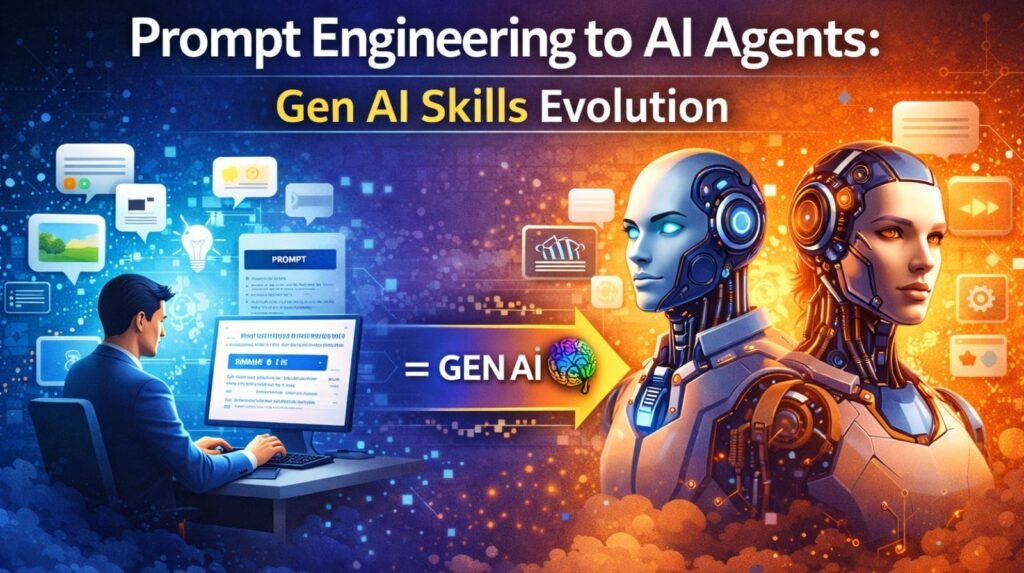
The landscape of is rapidly transforming as artificial intelligence (AI) skills evolve to encompass more than just crafting effective prompts. As we move through 2026, students, beginners, and aspiring AI professionals must recognize that the future of AI lies in developing capabilities that extend beyond traditional prompt-based interactions. This blog will explore the significant advancements in AI skills, the role of Prompt Engineering to AI Agents, and the essential skills needed for future careers in this dynamic field.
Introduction: The Rapid Evolution of AI Skills
In recent years, the demand for AI skills has surged, driven by the need for businesses to leverage technology for competitive advantage. Many professionals are now seeking AI skills for beginners to navigate this evolving landscape. The shift from basic prompt engineering to more advanced AI capabilities highlights the necessity for continuous learning and adaptation.
As AI technologies become more sophisticated, understanding how to effectively engage with these systems is crucial. The evolution of AI skills is not merely about mastering existing tools but also about anticipating future needs and opportunities. By embracing this evolution, aspiring AI professionals can position themselves at the forefront of innovation.
What is Prompt Engineering and Its Popularity?
Prompt engineering refers to the practice of designing and refining input prompts to optimize the performance of AI models. This skill gained popularity as businesses recognized the potential of generative AI to produce high-quality outputs based on user inputs. The rise of platforms utilizing AI for content generation, customer interactions, and data analysis has made prompt engineering a valuable asset.
The importance of understanding AI automation tools cannot be overstated. As organizations increasingly rely on AI to automate processes, the ability to create effective prompts becomes a critical skill. However, the focus on prompt engineering alone may not suffice in the face of emerging technologies and methodologies.
The Growth of Generative AI
Generative AI has seen exponential growth, with applications ranging from creative content creation to complex problem-solving. As more industries adopt these technologies, the demand for skilled professionals who can effectively harness their capabilities continues to rise.
The Role of Data in Prompt Engineering
Data plays a pivotal role in the effectiveness of prompt engineering. The quality and relevance of the data used to train AI models directly impact the outcomes generated. As a result, professionals must not only be adept at crafting prompts but also understand the underlying data structures and sources.
Introduction to AI Agents: Beyond Simple Prompts
AI agents are a new frontier in the world of artificial intelligence, representing a significant evolution from traditional prompt-based systems. Unlike simple prompts that require user input for each task, AI agents can perform autonomous tasks based on predefined parameters and learned behaviors. This capability allows them to operate independently, making decisions and taking actions without constant human intervention.
Organizations leveraging the future of AI in business are increasingly adopting AI agents to streamline operations and enhance productivity. These systems can analyze vast amounts of data, learn from interactions, and adapt their strategies to optimize outcomes.
The Mechanism of AI Agents
AI agents utilize machine learning algorithms to process information and make informed decisions. By analyzing patterns and trends, they can execute tasks ranging from scheduling meetings to managing complex workflows. This autonomy not only improves efficiency but also frees human resources for more strategic initiatives.
Use Cases of AI Agents
Several industries have begun implementing AI agents to revolutionize their operations. For example, in customer service, AI agents can handle inquiries and provide support without human oversight. In finance, they can analyze market trends and execute trades based on real-time data.
Comparing Prompt-Based Usage vs Agent-Based Systems
When comparing prompt-based usage with agent-based systems, several key differences emerge in terms of capability, efficiency, and real-world impact.
Capability
Prompt-based systems rely heavily on user input, limiting their functionality to the quality of the prompts provided. In contrast, agent-based systems can autonomously gather information, analyze it, and make decisions, significantly enhancing their capability to perform tasks.
Efficiency
The efficiency of agent-based systems is evident in their ability to operate continuously without the need for constant human input. This allows businesses to optimize workflows and reduce operational costs. For instance, organizations utilizing the importance of logic building in AI can create more robust AI agents capable of tackling complex tasks effectively.
Real-World Impact
The real-world impact of transitioning from prompt-based systems to agent-based systems is profound. Businesses that adopt AI agents can achieve higher levels of automation, leading to increased productivity and better resource allocation. This shift not only enhances operational efficiency but also fosters innovation by enabling teams to focus on strategic initiatives rather than routine tasks.
Why Learning Only Prompt Engineering is No Longer Enough in 2026
As we progress through 2026, the landscape of AI skills continues to evolve, and learning only prompt engineering is no longer sufficient for aspiring professionals. The rapid advancement of AI technologies necessitates a broader skill set that encompasses various aspects of AI development and implementation.
The Need for Automation Skills
With AI agents taking on more complex tasks, professionals must develop skills in automation. Understanding how to design and implement automated workflows is crucial for maximizing the potential of these technologies.
Embracing New Tools
As AI tools become more sophisticated, familiarity with emerging technologies is essential. Professionals should focus on learning new tools that enhance their ability to work with AI systems effectively. This includes understanding machine learning frameworks, data analysis tools, and AI development platforms.
The Importance of Logic Building
Logic building is a foundational skill that underpins successful AI implementation. Professionals must be able to construct logical frameworks that guide AI decision-making processes. By mastering this skill, individuals can ensure that AI systems operate effectively and align with organizational goals. Exploring the evolution of generative AI can provide valuable insights into the future of these technologies.
Examples of AI Automating Workflows and Business Tasks
The impact of AI on business processes is evident in numerous case studies where organizations have successfully implemented AI solutions to automate workflows and enhance productivity.
Case Study: AI in Marketing
In the marketing sector, AI tools have revolutionized how businesses engage with customers. By automating tasks such as email marketing and social media management, companies can streamline their operations and achieve better results. AI agents can analyze customer behavior, segment audiences, and personalize content, leading to improved engagement and conversion rates.
Case Study: AI in Supply Chain Management
AI has also transformed supply chain management by automating inventory management, demand forecasting, and logistics optimization. Businesses can utilize AI agents to analyze data in real-time, allowing for more accurate predictions and efficient resource allocation. This results in cost savings and improved customer satisfaction.
Skills to Learn Next: Automation, Tools, and Logic Building
To thrive in the evolving landscape of AI, aspiring professionals must focus on developing a diverse skill set that encompasses automation, tools, and logic building.
Automation Skills
Learning how to design and implement automated workflows will be crucial for maximizing the potential of AI technologies. Familiarity with automation tools and platforms will empower professionals to create efficient processes that enhance productivity.
Tools and Technologies
Staying updated on emerging AI tools and technologies is essential for professionals in the field. This includes exploring machine learning frameworks, data visualization tools, and AI development platforms that can enhance their ability to work with AI systems effectively.
Logic Building
Mastering logic building will enable professionals to construct robust frameworks for AI decision-making. This foundational skill is critical for ensuring that AI systems operate effectively and align with organizational objectives.
Conclusion: Future Careers in AI
As we look to the future, the evolution of AI skills presents exciting opportunities for aspiring professionals. The shift from prompt engineering to AI agents signifies a new era in which individuals must adapt to the changing landscape of technology. By embracing automation, mastering new tools, and developing strong logic-building skills, professionals can position themselves for success in the dynamic world of AI.
The future of AI careers is bright, with a growing demand for skilled individuals who can navigate the complexities of AI technologies. By staying informed and continuously learning, aspiring AI professionals can ensure they remain at the forefront of this rapidly evolving field.