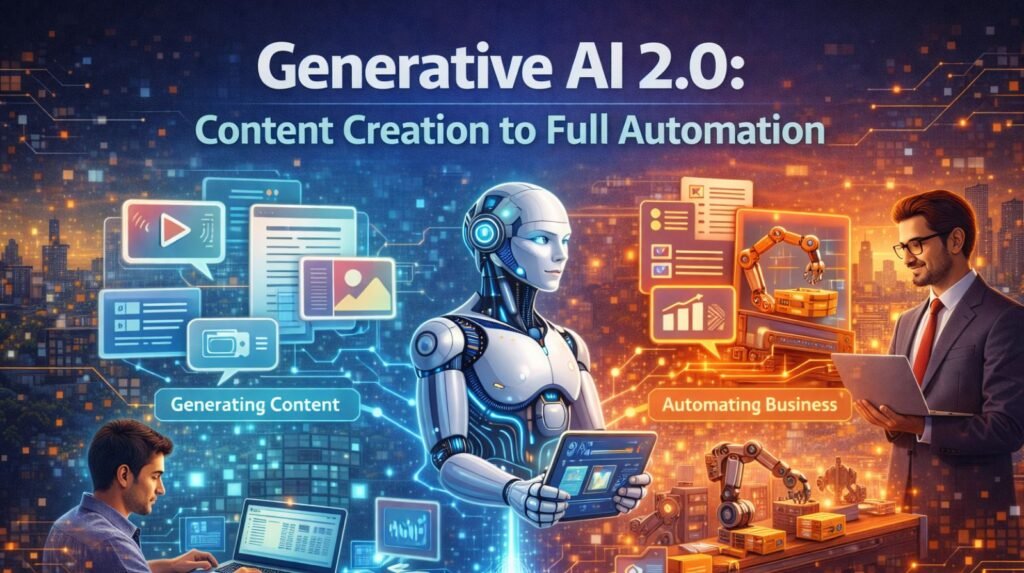
In the rapidly evolving landscape of technology, is emerging as a game-changer for businesses worldwide. This innovative technology is transcending its initial role as a content generation tool, evolving into a comprehensive AI workforce capable of managing entire business processes. By harnessing the power of Generative AI 2.0, companies are streamlining their operations, enhancing decision-making, and improving customer experiences. As we explore this transformation, it becomes clear that businesses leveraging business automation solutions are gaining a significant competitive edge in 2026.
Understanding Generative AI 2.0
Generative AI 2.0 represents a significant leap forward in artificial intelligence capabilities, moving beyond simple content creation to more complex tasks. This evolution allows AI systems to generate insights, automate workflows, and facilitate decision-making at unprecedented levels. In 2026, many businesses report that adopting Generative AI 2.0 has led to improved operational efficiency and innovation.
Key Features of Generative AI 2.0
Generative AI 2.0 is characterized by its ability to learn from vast datasets and produce outputs that mimic human-like creativity and reasoning. This includes generating text, images, and even complex strategic plans. The technology is also capable of integrating with existing business systems, making it a versatile tool for various applications.
Impact on Business Processes
The impact of Generative AI 2.0 on business processes is profound. Companies are increasingly using AI to streamline operations, reduce costs, and enhance customer engagement. This shift reflects a broader trend towards automation in business, where AI is becoming a critical component of strategic planning and execution.
The Evolution from Tool to Workforce
Historically, AI was viewed primarily as a tool to assist human workers. However, Generative AI 2.0 is redefining this perception by functioning as an autonomous workforce capable of executing tasks independently. This transformation is reshaping how businesses approach workflow management and operational efficiency.
Transitioning Roles in the Workplace
As Generative AI 2.0 takes on more responsibilities, the roles of human employees are evolving. Rather than performing repetitive tasks, workers are now focusing on strategic decision-making and creative problem-solving. This shift not only enhances job satisfaction but also drives innovation within organizations.
Challenges of Integration
While the transition from tool to workforce presents numerous opportunities, it also comes with challenges. Businesses must navigate the complexities of integrating AI into their existing frameworks. Developing AI workforce strategies that align with organizational goals is essential for maximizing the benefits of this technology.
AI in Workflow Automation
Workflow automation is one of the most significant applications of Generative AI 2.0. By automating repetitive tasks, businesses can free up valuable resources and focus on higher-level strategic initiatives. This not only increases efficiency but also allows for more agile responses to market changes.
Enhancing Productivity
With AI handling routine tasks, employees can dedicate more time to critical thinking and innovation. For instance, automating data entry and report generation can significantly reduce the workload on finance teams, allowing them to concentrate on strategic financial planning and analysis.
Streamlining Processes
Generative AI 2.0 can streamline processes across various departments, including marketing, finance, and operations. By implementing workflow automation tools, businesses can ensure that tasks are completed accurately and efficiently, leading to improved overall productivity.
AI in Decision-Making
The ability of Generative AI 2.0 to analyze vast amounts of data enables businesses to make informed decisions quickly. AI systems can identify trends, forecast outcomes, and recommend actions based on data-driven insights.
Data-Driven Insights
In 2026, organizations are increasingly relying on AI for data analysis and decision-making. This shift allows companies to respond to market dynamics with agility and precision. By leveraging decision-making with AI, businesses can enhance their strategic planning processes and improve their competitive positioning.
Reducing Bias in Decisions
AI systems can help mitigate human biases in decision-making. By relying on data rather than subjective opinions, organizations can make fairer and more objective choices. This is particularly valuable in hiring, promotions, and resource allocation, where bias can significantly impact outcomes.
AI in Customer Support
Customer support is another area where Generative AI 2.0 is making significant strides. AI-powered chatbots and virtual assistants are transforming how businesses interact with their customers, providing immediate responses and personalized experiences.
Improving Customer Experience
In 2026, many businesses report enhanced customer satisfaction due to the implementation of AI in their support systems. By utilizing customer support automation, companies can offer 24/7 assistance, addressing customer inquiries and issues promptly.
Scaling Support Operations
As businesses grow, scaling customer support can be challenging. Generative AI 2.0 allows companies to handle increasing volumes of inquiries without compromising service quality. This scalability is essential for maintaining customer loyalty and satisfaction.
AI in Operations at Scale
Generative AI 2.0 is not limited to specific functions; it can be integrated into various operational processes across an organization. This capability enables businesses to operate at scale while maintaining efficiency and effectiveness.
Streamlining Supply Chain Management
AI can optimize supply chain operations by predicting demand, managing inventory, and coordinating logistics. This allows businesses to minimize costs while ensuring that products are delivered on time.
Enhancing Project Management
With AI’s ability to analyze project data, businesses can improve their project management processes. AI can identify potential risks, allocate resources effectively, and ensure that projects stay on track, ultimately leading to better outcomes.
Real-World Use Cases of Autonomous AI Systems
Several companies are leading the way in adopting Generative AI 2.0, showcasing its potential to transform various industries. These real-world examples illustrate how autonomous AI systems are being utilized effectively.
Case Study: Retail Industry
A leading retail chain has implemented Generative AI 2.0 to optimize its inventory management and customer engagement strategies. By analyzing purchasing patterns and customer feedback, the AI system can forecast demand accurately, ensuring that the right products are available at the right time.
Case Study: Financial Services
In the financial sector, a major bank has adopted AI to enhance its risk assessment processes. By leveraging data analytics and machine learning, the bank can identify potential risks and make informed lending decisions, significantly reducing default rates.
Integrating AI into Core Business Functions
Integrating Generative AI 2.0 into core business functions is crucial for maximizing its benefits. This integration requires a strategic approach that aligns AI capabilities with organizational goals.
Marketing and Customer Engagement
AI can enhance marketing efforts by analyzing customer data and predicting behavior. This allows businesses to create targeted campaigns that resonate with their audience, leading to higher conversion rates.
Finance and Accounting
In finance, AI can automate routine tasks, such as bookkeeping and reconciliation, freeing up finance teams to focus on strategic initiatives. This integration not only improves efficiency but also enhances accuracy in financial reporting.
The Shift Towards Efficiency and Cost Reduction
As Generative AI 2.0 becomes more prevalent, businesses are experiencing a shift towards greater efficiency and cost reduction. This transition is reshaping the competitive landscape across industries.
Reducing Operational Costs
By automating processes and enhancing decision-making, companies can significantly reduce their operational costs. This reduction allows businesses to allocate resources more effectively and invest in growth initiatives.
Driving Innovation
The efficiency gained through AI integration fosters a culture of innovation within organizations. Employees are empowered to explore new ideas and solutions, driving continuous improvement and adaptation in a rapidly changing market.
Future of AI in Business: Minimal Human Intervention?
Looking ahead, the future of AI in business raises intriguing questions about the role of human intervention. As Generative AI 2.0 continues to evolve, will companies operate with minimal human oversight?
The Potential for Autonomous Operations
In 2026, many experts predict that businesses will increasingly rely on autonomous AI systems to manage operations. This shift could lead to a new era of efficiency, where AI handles routine tasks and decision-making with minimal human input.
Balancing AI and Human Intelligence
While the potential for minimal human intervention is significant, it is essential to maintain a balance between AI and human intelligence. Human oversight will remain crucial in areas that require empathy, creativity, and complex decision-making.
Conclusion
Generative AI 2.0 is transforming the landscape of business automation, evolving from a simple content creation tool to a powerful AI workforce capable of managing entire business processes. As companies embrace this technology, they are experiencing enhanced efficiency, cost reduction, and scalability. In 2026, the future of AI in business appears bright, with the potential for minimal human intervention as organizations increasingly rely on intelligent AI systems to drive their operations. Embracing this shift will be vital for businesses looking to thrive in an increasingly competitive environment.