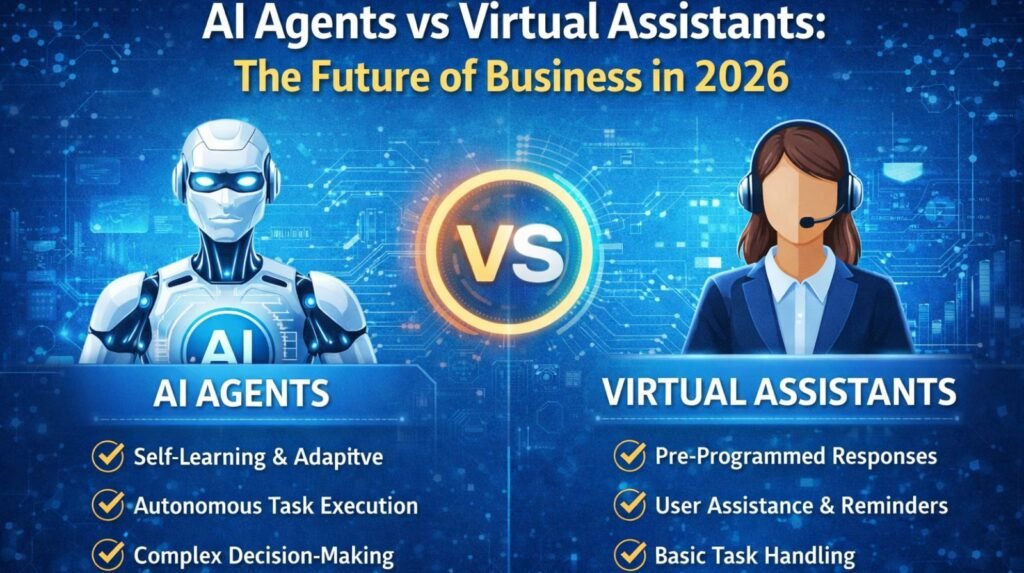
- What are AI Agents vs Virtual Assistants?
As we navigate through 2026, ai agents the landscape of business technology is rapidly evolving, especially with the rise of . These two technologies are transforming how businesses operate, engage with customers, and automate processes. Understanding the nuances between these two can help SMEs leverage them effectively for growth and efficiency.
What are AI Agents vs Virtual Assistants?
AI Agents and Virtual Assistants are both designed to assist users, but they operate on different principles. AI Agents are sophisticated systems that can perform complex tasks autonomously, learning and adapting over time. They are designed to handle intricate decision-making processes and can operate without human intervention in many scenarios. In contrast, Virtual Assistants are more task-oriented, performing specific functions based on user commands. They rely heavily on pre-programmed responses and do not learn or adapt as extensively as AI Agents.
Businesses using AI in business automation gain a competitive edge by incorporating AI Agents, which can analyze vast datasets and make informed decisions. For instance, an AI Agent in a retail setting can optimize inventory management by predicting trends based on customer behavior, whereas a Virtual Assistant might simply manage stock levels based on existing orders.
The Evolution of AI Technologies
In 2026, AI technologies have advanced significantly. AI Agents now utilize deep learning algorithms that allow them to process information more like a human brain, making them invaluable in complex environments. Virtual Assistants, while still effective for routine tasks, are increasingly being integrated with AI capabilities to enhance their functionality.
Use Cases in Business Operations
AI Agents are particularly beneficial in sectors like finance, where they can analyze market trends and make investment recommendations. Virtual Assistants, on the other hand, excel in customer service roles, handling inquiries and scheduling appointments efficiently. Understanding these roles can help businesses decide which technology suits their needs better.
Key Differences (Automation vs Autonomy)
The fundamental difference between AI Agents and Virtual Assistants lies in their operational capabilities. AI Agents represent autonomy, able to make decisions and learn from experiences. In contrast, Virtual Assistants are primarily about automation, executing tasks based on user input without learning from past interactions.
Businesses using impact of AI on jobs gain a competitive edge by recognizing these differences. For example, an AI Agent can autonomously manage a marketing campaign, analyzing data to adjust strategies in real-time, while a Virtual Assistant would require constant human direction to execute similar tasks.
Decision-Making Capabilities
AI Agents can evaluate multiple factors in real-time, making them suitable for dynamic environments where quick decisions are crucial. Virtual Assistants, however, follow a set protocol, which can lead to inefficiencies in rapidly changing scenarios.
Learning and Adaptability
AI Agents continuously learn from their interactions, improving their performance over time. This adaptability is essential for businesses looking to stay ahead in competitive markets. Virtual Assistants, while helpful, do not possess this learning ability, making them less suitable for complex tasks.
Real Use Cases in 2026
By 2026, numerous businesses have successfully integrated both AI Agents and Virtual Assistants into their operations. For instance, a leading e-commerce platform employs AI Agents to personalize shopping experiences by analyzing customer behavior and preferences. This not only enhances customer satisfaction but also boosts sales.
Businesses using AI in customer support have seen remarkable improvements in response times and customer engagement. AI Agents can handle multiple inquiries simultaneously, while Virtual Assistants manage follow-ups and routine questions.
Case Study: E-commerce Personalization
An e-commerce giant utilized an AI Agent to analyze purchasing patterns and recommend products to users. This resulted in a 30% increase in sales conversions over six months, demonstrating the power of AI Agents in driving revenue.
Case Study: Customer Service Automation
A financial services firm integrated a Virtual Assistant to handle basic customer inquiries, freeing up human agents for more complex issues. This improved efficiency by 40%, showcasing how Virtual Assistants can optimize workforce allocation.
Impact on Jobs & Skills
The rise of AI technologies is reshaping the job market. While there is concern about AI Agents replacing human jobs, the reality is more nuanced. Many businesses report that AI is augmenting human capabilities rather than replacing them.
Businesses using future-proof AI models gain a competitive edge by focusing on the skills that will be in demand. Employees will need to adapt to working alongside AI technologies, emphasizing the importance of continuous learning and upskilling.
New Skill Requirements
As AI Agents become more prevalent, there will be a growing need for skills in data analysis, machine learning, and AI management. Workers who can effectively collaborate with AI technologies will be in high demand, making it essential for businesses to invest in training their teams.
Job Transformation
While some roles may become obsolete, new positions that focus on managing and optimizing AI technologies will emerge. This transformation presents an opportunity for businesses to create innovative roles that leverage human creativity and AI efficiency.
Future of Work: Replace or Collaborate?
The question of whether AI will replace human jobs is a pressing concern for many. However, the future of work appears to be one of collaboration rather than replacement. AI Agents and Virtual Assistants are tools that can enhance human productivity, allowing employees to focus on higher-level tasks.
Businesses using AI automation vs AI autonomy gain a competitive edge by recognizing the value of collaboration. For instance, a marketing team can use AI Agents to analyze data and generate insights, while team members focus on creative strategy and execution.
Benefits of Collaboration
Collaborating with AI technologies can lead to increased efficiency and innovation. By allowing AI to handle routine tasks, employees can dedicate more time to strategic initiatives, ultimately driving business growth.
Preparing for the Future
To thrive in this collaborative environment, businesses must foster a culture of adaptability. Encouraging employees to embrace AI technologies and providing training will be crucial for long-term success.
AI agents kya hote hain?
AI agents are advanced systems that can perform tasks autonomously, learning and adapting over time. They are designed to handle complex decision-making processes without human intervention.
Virtual assistants aur AI agents mein kya difference hai?
The key difference lies in their functionality. Virtual assistants are task-oriented, executing specific commands based on user input, while AI agents operate autonomously, making decisions based on learned data.
Kya AI agents human jobs replace kar denge?
AI agents are more likely to augment human jobs rather than replace them. They can handle routine tasks, allowing humans to focus on more complex and creative work.
2026 mein kaunsa AI zyada powerful hai?
In 2026, AI agents are considered more powerful due to their ability to learn and adapt autonomously, making them suitable for complex business environments.
Businesses ko AI agents adopt karna chahiye ya nahi?
Yes, adopting AI agents can provide businesses with a competitive edge by enhancing efficiency, decision-making, and customer engagement.