Understanding AI vs Traditional Automation
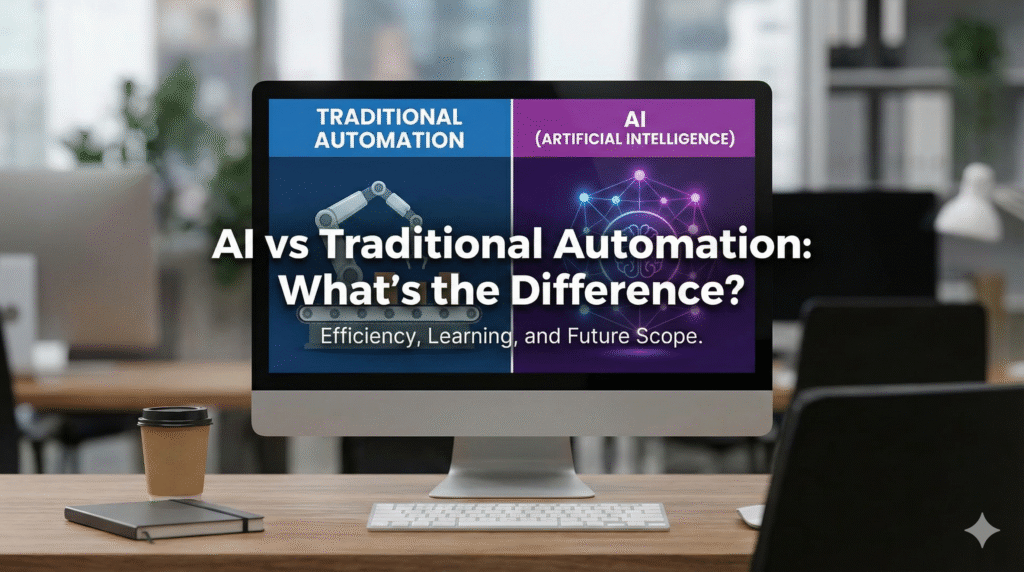
AI (Artificial Intelligence) learns and adapts from data to make intelligent decisions, while traditional automation follows pre-programmed rules to perform repetitive tasks. AI systems improve over time through machine learning, whereas conventional automation executes fixed workflows without learning capabilities or contextual understanding.
Introduction: The Evolution of Business Automation
In today’s rapidly evolving technological landscape, businesses face a critical choice between implementing AI solutions and sticking with traditional automation systems. While both technologies aim to streamline operations and reduce manual effort, AI and traditional automation operate on fundamentally different principles. Understanding these differences is essential for organizations looking to optimize their processes and stay competitive in the digital age.
The confusion between artificial intelligence and conventional automation is understandable—both promise efficiency gains and cost reduction. However, the capabilities, implementation requirements, and long-term value propositions of these technologies differ dramatically. This comprehensive guide will explore the core distinctions between AI and traditional automation, helping you make informed decisions about which approach best suits your business needs.
What is Traditional Automation?
Traditional automation refers to technology systems that perform predefined tasks following explicit, rule-based instructions. These systems execute repetitive processes consistently and efficiently, but they lack the ability to learn, adapt, or handle scenarios outside their programmed parameters.
Manufacturing assembly lines exemplify traditional automation—robotic arms perform specific movements repeatedly, welding or assembling components with precision. Similarly, email auto-responders, scheduled data backups, and basic chatbots that follow decision trees all represent traditional automation solutions.
The key characteristic of traditional automation is its deterministic nature. If you input A, you always get output B. These systems excel at high-volume, repetitive tasks where consistency matters more than flexibility. However, they require human intervention when encountering exceptions or new situations not covered by their programming.
What is Artificial Intelligence?
Artificial intelligence represents a paradigm shift from rule-based programming to systems that learn from data and experience. AI technologies use machine learning algorithms, neural networks, and deep learning to identify patterns, make predictions, and improve performance over time without explicit programming for every scenario.
Unlike traditional automation, AI systems can handle ambiguity, understand context, and make decisions in complex, unpredictable environments. Modern AI applications include natural language processing for chatbots that understand conversational nuances, computer vision systems that identify defects in manufacturing, and predictive analytics that forecast customer behavior.
Artificial intelligence encompasses various subfields including machine learning, where algorithms improve through exposure to data; natural language processing, which enables machines to understand human language; and computer vision, allowing systems to interpret visual information. These capabilities enable AI to tackle problems that would be impossible for traditional automation to solve.
Core Differences Between AI and Traditional Automation
Decision-Making Capabilities
Traditional automation makes decisions based on predetermined if-then logic. A system might route customer emails to specific departments based on keywords, but it cannot understand sentiment or complex requests requiring judgment.
AI, conversely, makes probabilistic decisions based on learned patterns. An AI-powered customer service system doesn’t just match keywords—it understands context, sentiment, and intent, routing tickets appropriately even when customers describe issues using novel language.
Learning and Adaptation
The most significant difference lies in learning capability. Traditional automation systems remain static unless humans modify their code. If business rules change, developers must manually update the automation logic.
Artificial intelligence systems continuously improve through exposure to new data. An AI fraud detection system becomes more accurate over time, learning to identify new fraud patterns without explicit programming. This self-improvement capability represents a fundamental advantage over traditional automation.
Handling Complexity and Exceptions
Traditional automation struggles with exceptions. When a process encounters something outside its programmed rules, it typically fails or requires human intervention. This limitation restricts conventional automation to highly structured, predictable workflows.
AI thrives in complex, ambiguous environments. Whether analyzing medical images for disease indicators, optimizing supply chain logistics amid disruptions, or personalizing customer experiences based on behavior patterns, artificial intelligence handles variability and complexity that would paralyze traditional automation systems.Data Requirements
Traditional automation requires minimal data—just enough to define the rules and test the workflow. Implementation focuses on process mapping and logic design rather than data collection.
AI systems are data-hungry. Artificial intelligence models require substantial training data to learn patterns effectively. The quality, quantity, and diversity of training data directly impact AI performance, making data strategy crucial for successful implementation.
Practical Applications: When to Use Each Approach
Best Use Cases for Traditional Automation
Traditional automation excels in scenarios requiring:
- Predictable, repetitive tasks: Data entry, report generation, and scheduled backups benefit from rule-based automation
- High-precision operations: Manufacturing processes requiring exact repeatability work well with conventional automation
- Simple decision trees: Basic customer inquiries that follow clear pathways suit traditional automated systems
- Compliance-driven processes: Workflows requiring audit trails and complete determinism favor traditional automation
Industries like manufacturing, logistics, and financial processing have successfully deployed traditional automation for decades, achieving significant efficiency gains in structured environments.
Ideal Scenarios for Artificial Intelligence
AI provides superior value when facing:
- Unstructured data processing: Analyzing text documents, images, or audio requires artificial intelligence capabilities
- Predictive analytics: Forecasting sales, predicting equipment failures, or anticipating customer churn leverage AI pattern recognition
- Personalization at scale: Recommending products, customizing content, or tailoring user experiences benefit from AI learning
- Natural language interaction: Customer service chatbots, voice assistants, and sentiment analysis require artificial intelligence
Healthcare diagnostics, financial fraud detection, personalized marketing, and autonomous systems represent domains where AI delivers transformative capabilities beyond traditional automation reach.
Implementation Considerations
Cost and Complexity
Traditional automation typically involves lower upfront costs and faster implementation. Organizations can deploy rule-based systems without extensive data infrastructure or specialized expertise, making conventional automation accessible for small to medium businesses.
Artificial intelligence demands greater investment in data infrastructure, computational resources, and specialized talent. However, AI systems often provide better ROI long-term through continuous improvement and handling complex tasks that manual processes or traditional automation cannot address efficiently.
Maintenance and Evolution
Traditional automation requires ongoing maintenance as business rules change. Updates need developer intervention, creating dependencies and potential delays in adapting to new requirements.
AI systems require different maintenance—monitoring model performance, updating training data, and occasionally retraining models. While this demands data science expertise, artificial intelligence systems adapt more fluidly to changing conditions once proper monitoring frameworks exist.
The Future: Hybrid Approaches
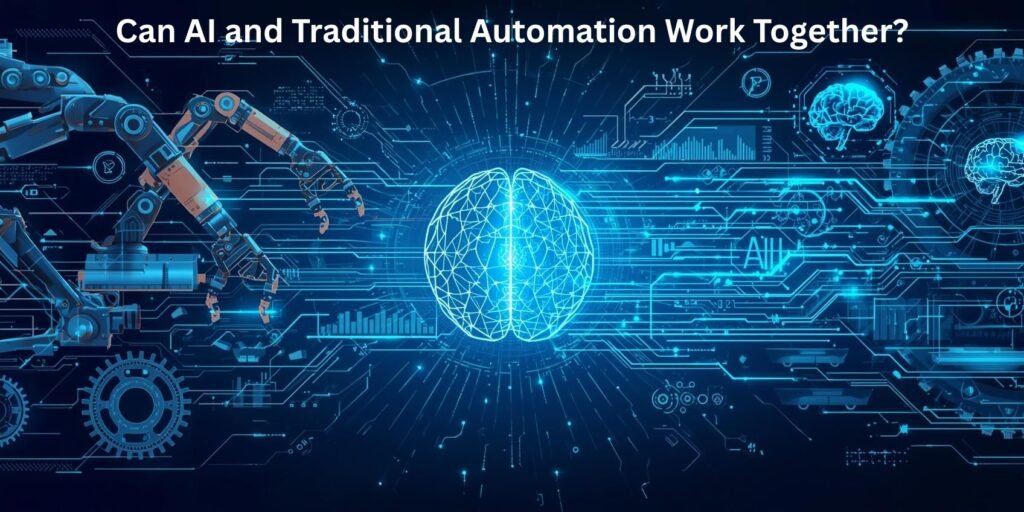
Leading organizations increasingly combine AI and traditional automation in hybrid architectures. This approach leverages traditional automation for structured, predictable workflows while deploying artificial intelligence for complex decision-making and adaptive processes.
For example, a customer service platform might use traditional automation to route inquiries to appropriate departments while employing AI to analyze sentiment, predict customer needs, and generate personalized responses. This combination optimizes both efficiency and intelligence, delivering superior results than either technology alone.
Conclusion: Choosing the Right Technology
The choice between AI and traditional automation isn’t binary—it depends on your specific requirements, resources, and objectives. Traditional automation remains highly effective for structured, rule-based processes where consistency and predictability matter most. These systems deliver reliable efficiency gains with manageable complexity and cost.
Artificial intelligence represents the frontier for organizations facing complex, data-rich challenges requiring adaptation and learning. While AI demands greater investment and expertise, it enables capabilities impossible with conventional automation, from understanding natural language to making nuanced predictions in uncertain environments.
Most organizations will benefit from a strategic combination of both technologies, applying traditional automation where appropriate while investing in artificial intelligence for high-value, complex processes that benefit from learning and adaptation. Understanding these distinctions empowers you to make technology choices aligned with your business strategy and operational realities.