Why Autonomous Research Agents Are Suddenly Everywhere
The landscape of research and development is experiencing one of the fastest and most profound transformations in modern history. For decades, R&D cycles in biotech, software, hardware, and academic research were limited by the speed and capacity of human teams. Even with advanced tools, the process of exploring papers, running experiments, generating insights, and validating hypotheses required enormous time, coordination, and resources. But today, a new category of AI systems—known as autonomous research agents—is reshaping the very fabric of innovation. Tools like Devin, RecurseAI, and emerging agentic research frameworks are proving that artificial intelligence can do far more than automate tasks. These systems can think, reason, evaluate evidence, synthesize ideas, and operate as true research collaborators. This is why the topic is trending globally: research agents do not just speed up innovation; they redefine innovation itself.
What Exactly Are Autonomous Research Agents?
Autonomous research agents are advanced AI systems capable of performing multi-step research workflows with minimal or no human oversight. Unlike traditional models that simply generate answers or summarize text, these agents can independently explore scientific literature, interpret complex datasets, plan experiments, test hypotheses, and generate research insights that match or exceed the pace of human teams. In practical terms, they behave like digital researchers—reading, analyzing, organizing, and synthesizing knowledge across millions of documents at speeds no human could replicate.
The defining feature of autonomous research agents is their agentic ai capability. They do not merely react; they take initiative. Give them a research objective—such as exploring a new drug target, identifying performance bottlenecks in a neural network, evaluating emerging materials for clean energy systems, or comparing industrial design approaches—and they automatically design a workflow, gather the necessary sources, examine evidence, and produce actionable outcomes. This shift changes the role of the human researcher from executor to supervisor, enabling teams to work at a scale that was previously unimaginable.
How Research Agents Read, Analyze, and Generate Insights
The core strength of autonomous research agents lies in their ability to ingest vast quantities of information and convert it into meaningful insights. They begin by scanning thousands of academic papers, patents, technical blogs, simulation outputs, and internal research documents. Instead of passively summarizing content, the agents identify patterns, contradictions, knowledge gaps, and potential breakthroughs. They can trace the evolution of an idea, compare findings across disciplines, and even map entire research landscapes in a matter of hours.
Once equipped with the conceptual foundation, these agents move into analysis. They evaluate methodologies, examine statistical results, and interpret diagrams, experimental structures, and code. In fields like machine learning, the Agentic AI can read research codebases, execute experiments, debug issues, and propose modifications. In biotech, the AI may analyze genomic data, investigate molecular interactions, or simulate biological pathways. In engineering disciplines, research agents can run simulations, optimize designs, and compare model outputs with existing literature. The result is an analysis pipeline that mirrors the depth and rigor of human researchers but operates at machine speed.
Running Experiments and Guiding the R&D Process
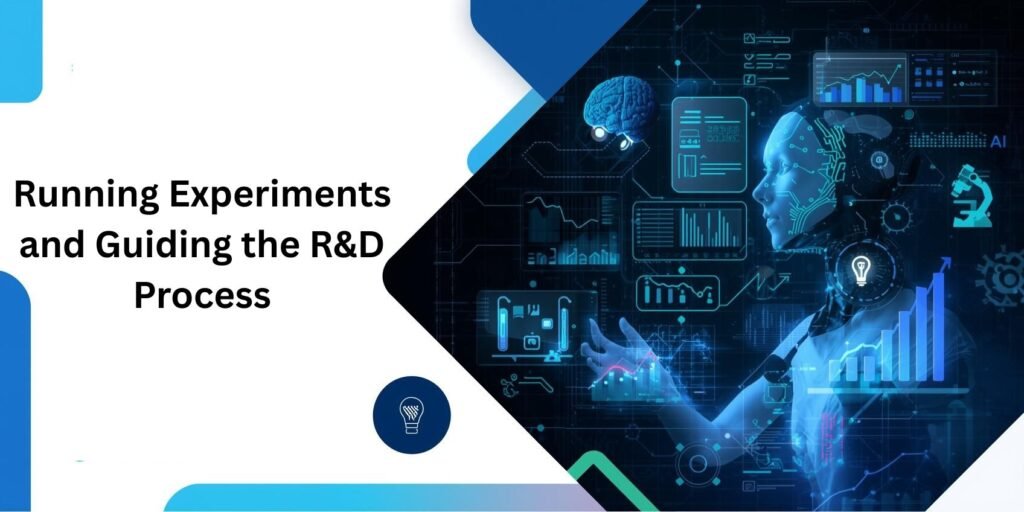
One of the most revolutionary capabilities of autonomous research agents is their ability to run experiments—digitally or physically. For software development, research agents can run code-based experiments, test hypotheses, benchmark model architectures, and refine algorithms rapidly. New AI agents like Devin are already demonstrating end-to-end execution in software research, from reading documentation to writing code to testing it.
In biotechnology and chemistry, research agents integrate with lab automation tools, enabling AI-driven lab cycles. They can choose reagents, set parameters, control robotic lab equipment, analyze wet-lab outputs, and iterate through experimental loops continuously. This convergence of AI and robotics has birthed the concept of the “self-driving lab,” where experimentation becomes a fully autonomous workflow.
In hardware engineering and industrial R&D, autonomous Agentic AI can simulate stress tests, perform material modeling, optimize designs, and compare prototypes. They can evaluate thousands of variations of a product idea long before a human team gets involved. This eliminates guesswork and drastically shortens product development timelines. The common theme across all domains is the same: research agents do not simply provide answers—they accelerate discovery at every stage.
Transformative Impact Across Biotech, Software, Hardware, and Academia
Biotechnology is seeing some of the earliest and most dramatic impacts. Autonomous agents are helping researchers identify new protein structures, analyze drug interaction models, and explore pathways for gene editing. Tasks that previously required multiple PhD teams working for months can now be completed in days. As a result, pharmaceutical pipelines are speeding up, biomolecule design is becoming more precise, and experimental error rates are decreasing.
In software development and computer science, these agents serve as autonomous developers and research engineers. They interpret research papers, implement complex algorithms, stress-test architectures, and write optimized code. Research cycles in AI, cybersecurity, and computational science are accelerating quickly because AI can explore edge cases, simulate attacks, or test hypotheses faster than human researchers.
Hardware and engineering disciplines are also benefiting as agents analyze CAD files, run physics simulations, evaluate thermal patterns, and adjust structural elements. When designing chips, batteries, robotics systems, or aerospace components, research agents can test thousands of configurations before selecting the optimal one, dramatically reducing the prototyping phase.
Academic research is undergoing a renaissance as well. Scholars can now collaborate with research Agentic AI that read entire academic fields, identify gaps worth exploring, and even propose paper outlines or experimental structures. Students and researchers who previously struggled with literature overload now have an intelligent partner capable of navigating the informational universe with ease.
The Implications for Innovation Culture and Research Teams
The arrival of autonomous research agents is beginning to shift how teams approach innovation. Instead of starting with weeks or months of manual review, teams jump into the creative phase immediately because the AI handles the heavy intellectual lifting. Brainstorming becomes richer and faster when backed by an AI that understands thousands of research trajectories simultaneously. Teams spend more time in strategy and synthesis, less time in tedious information gathering.
This shift also democratizes research. Small teams and early-stage startups with limited budgets can now compete with large research institutions because they have access to AI systems that dramatically lower the cost of exploration. Independent researchers gain superpowers that allow them to pursue ambitious ideas without requiring large labs or funding. Innovation is no longer restricted to those with the biggest resources; it becomes accessible to anyone with creativity and the willingness to collaborate with intelligent agents ai.
However, this transformation raises important cultural questions. What becomes of traditional research hierarchies when AI can outperform junior researchers in analysis? How should teams attribute insight when the discovery emerges from human-AI collaboration? The shift is forcing organizations to rethink not just workflows, but their entire identity as innovation-driven entities.
The Future of AI-Led Innovation Teams
Looking ahead, autonomous research agents will form the backbone of next-generation innovation teams. Instead of relying on linear, human-centered R&D workflows, companies will operate hybrid teams where humans and AI collaborate seamlessly. Humans will set objectives, evaluate risk, and provide ethical judgment, while Agentic AI perform continuous research, experimentation, and optimization in the background. Multi-agent systems will collaborate with each other, with one agent specializing in literature analysis, another in simulations, another in experimental design, and another in validation.
Entire R&D cycles will compress from years to months and from months to days. Companies will be able to explore dozens of product ideas simultaneously, abandoning or doubling down based on data-driven insights generated autonomously. Academia will evolve into an environment where researchers serve as supervisors of large AI-driven research clusters. Scientific progress will accelerate as barriers around labor, time, and information overload vanish.
The ultimate shift is that innovation will no longer depend solely on human intellectual bandwidth. Autonomous research agents will extend the cognitive horizon of humanity, allowing us to explore more ideas, design more solutions, and pursue more breakthroughs than ever before. They will not replace human curiosity or creativity, but they will amplify it beyond what we currently believe is possible.