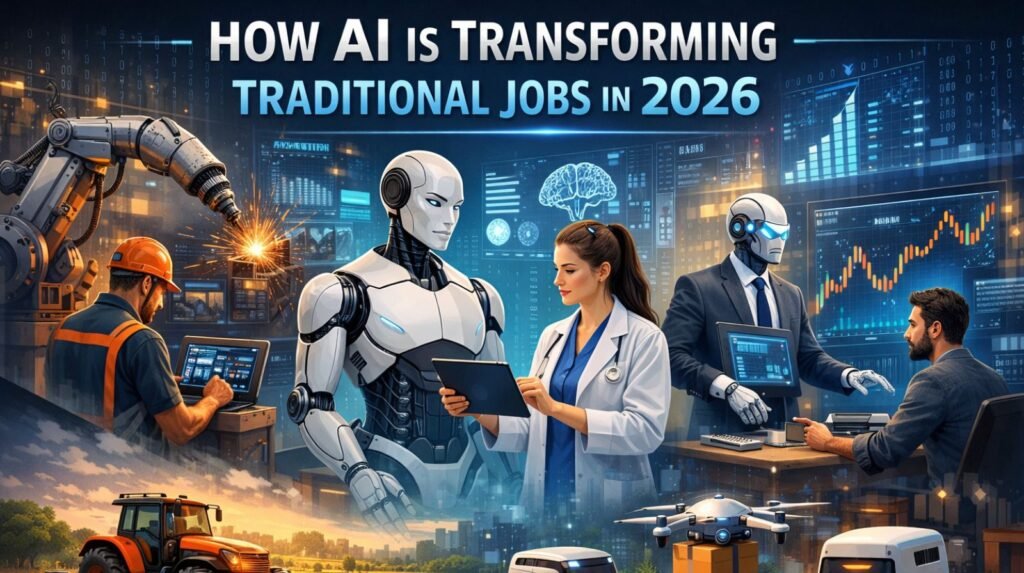
The conversation around job displacement often focuses on blue-collar roles, but recent trends reveal a startling truth: across all sectors, including white-collar positions like analysts, marketers, and managers. As we step into 2026, the landscape of work is evolving rapidly. Understanding how AI is transforming traditional jobs roles and what skills will be crucial for the future is essential for students and young professionals eager to thrive in this new environment.
Introduction: Challenging the Myth of Job Replacement
The narrative that AI primarily threatens blue-collar jobs is outdated. In 2026, many businesses are recognizing that the extends far beyond the factory floor. Roles that require analytical thinking, creativity, and interpersonal skills are also being transformed. For instance, marketing professionals now rely on AI-driven insights to tailor campaigns more effectively, while analysts use machine learning tools to sift through vast datasets quickly.
This shift is not merely about job loss; it’s about transformation. AI is redefining how tasks are performed, allowing professionals to focus on higher-level strategic initiatives. Instead of fearing job replacement, individuals should focus on how to adapt and leverage AI tools to enhance their capabilities.
The Impact of AI on Blue-Collar vs. White-Collar Jobs
While blue-collar jobs have traditionally been viewed as more vulnerable to automation, a closer examination shows that . In 2026, many sectors are witnessing a significant shift in job functions. For example, administrative roles are increasingly being automated through AI-powered software that manages scheduling and communication.
However, this does not mean that all jobs will disappear. Instead, many positions will evolve. A report from industry experts indicates that approximately 40% of tasks currently performed by white-collar workers could be automated. This statistic highlights the necessity for professionals to adapt by developing new skills. Businesses that focus on skills for the future gain a competitive edge, ensuring their workforce is equipped to handle emerging challenges.
Key Differences in Job Displacement
- : Blue-collar jobs often involve repetitive physical tasks, while white-collar roles may include cognitive tasks that require critical thinking and decision-making.
- : White-collar workers have more opportunities to pivot into new roles that leverage their existing skills, as the nature of their work is often less rigid than that of blue-collar jobs.
- : The demand for new skills is rising across both sectors, but white-collar workers may have more access to training and development resources.
Case Studies of Job Transformation
Consider the case of a marketing analyst. In 2026, many analysts are using AI tools to analyze consumer behavior, allowing them to create more targeted marketing strategies. This shift has led to a demand for professionals who can interpret AI-generated data and make strategic decisions based on those insights.
Similarly, in the finance sector, roles like financial analysts are being transformed by AI that can predict market trends and automate reporting tasks. This evolution emphasizes the need for finance professionals to enhance their skills in data interpretation and strategic planning.
How Automation and Generative AI Are Transforming Industries
Automation and generative AI are at the forefront of this transformation, reshaping industries in profound ways. In 2026, businesses are increasingly adopting these technologies to improve efficiency and reduce costs. For instance, customer service roles are being augmented by AI chatbots that can handle routine inquiries, freeing human agents to tackle more complex issues.
The Rise of Automation
Automation is streamlining processes across various sectors. In manufacturing, robotic systems are taking over repetitive tasks, while in healthcare, AI is assisting doctors in diagnosing diseases more accurately. This shift allows human workers to focus on patient care and complex problem-solving.
Generative AI in Creative Fields
Generative AI is also making waves in creative industries. In 2026, designers and content creators are using AI tools to generate ideas and prototypes, speeding up the creative process. For example, graphic designers can leverage AI to create multiple design variations quickly, allowing them to focus on refining concepts rather than starting from scratch.
Businesses using automation in the workplace gain a competitive edge, as they can operate more efficiently and respond to market changes faster than ever before.
Redefining Job Roles: What Does the Future Hold?
As AI continues to evolve, job roles will be redefined. In 2026, professionals will need to adapt to a landscape where collaboration with AI is the norm. This shift necessitates a change in how we view our careers and the skills we prioritize.
New Job Titles and Roles
Emerging job titles such as AI Ethics Consultant, Data Curator, and AI Interaction Designer are becoming more common. These roles require a blend of technical knowledge and soft skills, reflecting the importance of human insight in an AI-driven world.
Collaboration Between Humans and AI
The future of work will likely see a hybrid model where humans and AI work together. For example, in project management, AI can assist in scheduling and resource allocation, while human managers focus on team dynamics and strategic direction. This collaboration emphasizes the need for professionals to be adaptable and open to learning new tools.
Businesses utilizing generative AI gain a competitive edge by harnessing the power of technology to enhance creativity and innovation in their operations.
Skills in Demand: Preparing for an AI-Driven World
To thrive in an AI-driven world, certain skills are becoming increasingly valuable. In 2026, professionals must focus on developing a mix of technical and soft skills to remain relevant.
AI Literacy
Understanding how AI works and its implications is crucial. AI literacy enables professionals to use AI tools effectively and make informed decisions based on AI-generated insights.
Prompt Engineering
Prompt engineering is a new skill set that involves crafting effective prompts for AI systems to generate desired outcomes. This skill is becoming essential for professionals across various sectors, as it directly influences the quality of AI-generated content.
Critical Thinking and Creativity
In a world where AI can handle routine tasks, critical thinking and creativity are paramount. Professionals who can analyze complex problems and devise innovative solutions will stand out in the job market.
Strategic Decision-Making
The ability to make strategic decisions based on data-driven insights is becoming increasingly important. Professionals must learn how to interpret AI-generated data and use it to inform their strategies.
Businesses that prioritize AI is transforming traditional jobs gain a competitive edge by ensuring their teams are equipped with the skills needed for the future.
Real-World Examples of AI in Action
Several companies are leading the way in integrating AI into their operations, showcasing the potential of this technology.
Google: AI in Marketing
Google has implemented AI tools in its marketing strategies, allowing for more personalized advertising. By analyzing user data, Google’s AI can predict user preferences and tailor ads accordingly, resulting in higher engagement rates.
IBM: AI in Healthcare
IBM’s Watson is revolutionizing healthcare by assisting doctors in diagnosing diseases and suggesting treatment options based on vast datasets. This integration of AI not only improves patient outcomes but also enhances the efficiency of healthcare professionals.
Practical Insights for Students and Young Professionals
As students and young professionals navigate this changing landscape, several practical insights can help them prepare for the future.
Embrace Lifelong Learning
Continuous learning is essential in an AI-driven world. Professionals should seek out opportunities for upskilling and reskilling, whether through online courses, workshops, or industry conferences.
Network and Collaborate
Building a network of like-minded professionals can provide support and opportunities for collaboration. Engaging with others in the field can lead to valuable insights and potential job opportunities.
Stay Informed About Industry Trends
Keeping up with industry trends and advancements in AI is transforming traditional jobs will help professionals remain relevant. Subscribing to industry publications, attending webinars, and participating in forums can provide valuable knowledge.
Conclusion: Embracing AI and the Future of Work
In 2026, the landscape of work is undeniably changing, with and redefining roles across industries. Rather than fearing this transformation, students and young professionals should embrace the opportunity to adapt and upskill. By focusing on developing critical skills such as AI literacy, prompt engineering, and strategic decision-making, individuals can position themselves for success in an AI-driven world. The future of work is not about resisting change but about embracing it and leveraging AI to enhance our capabilities.
How is AI impacting traditional jobs?
AI is impacting traditional jobs by automating repetitive tasks and transforming job roles across various sectors. This shift requires professionals to adapt and develop new skills to remain relevant in the evolving job market.
What skills will be in demand in the future job market?
In the future job market, skills such as AI literacy, prompt engineering, critical thinking, creativity, and strategic decision-making will be in high demand. These skills enable professionals to leverage AI effectively and make informed decisions.
Are white-collar jobs at risk due to AI?
Yes, white-collar jobs are at risk due to AI, as many tasks traditionally performed by these roles can be automated. However, this also presents opportunities for professionals to adapt and take on new responsibilities.
What is prompt engineering?
Prompt engineering is the skill of crafting effective prompts for AI systems to generate desired outcomes. This skill is becoming increasingly important as AI tools are integrated into various industries.
How can students prepare for an AI-driven workforce?
Students can prepare for an AI-driven workforce by embracing lifelong learning, networking with professionals, and staying informed about industry trends. Upskilling and reskilling will be crucial for future success.