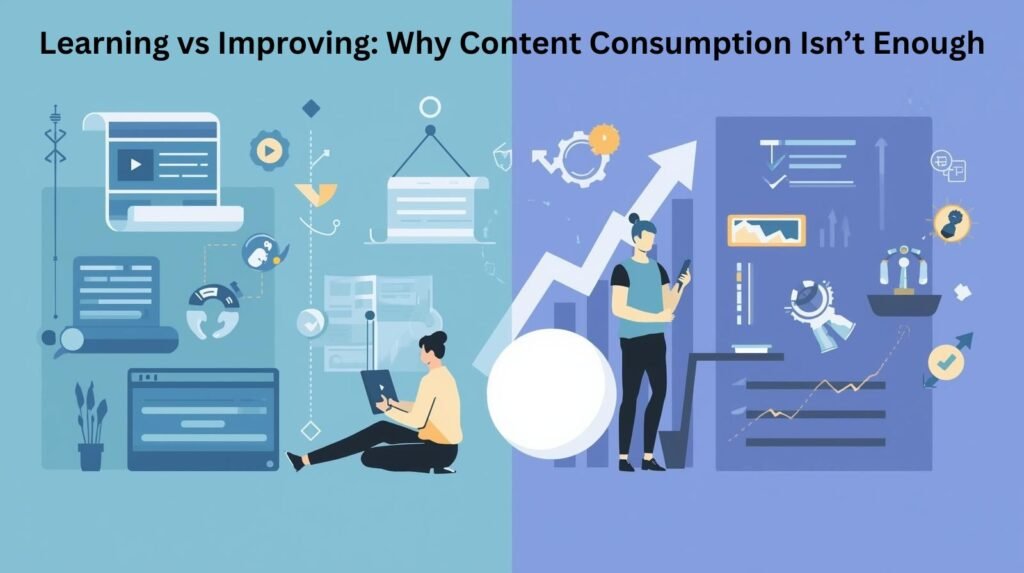
People are learning more than ever—yet improving less than ever.
Courses, tutorials, reels, podcasts, newsletters. Every day there’s new content promising growth. And most people are busy consuming it. But when you look at real outcomes—skills, confidence, execution, career movement—there’s barely any change. That’s because learning vs improving are not the same thing. And confusing the two is quietly killing progress.
The Illusion of Learning
Learning feels productive.
Watching a video.
Completing a course.
Saving notes.
Earning a certificate.
Your brain gets a dopamine hit. You feel like you’re moving forward. But in reality, you’re often just accumulating information, not building capability.
Improvement, on the other hand, is uncomfortable:
You try something and fail
You apply knowledge and realize gaps
You get stuck and have to think
You look stupid before you look skilled
Most people avoid this phase. So they stay in “Learning vs Improving mode” forever.
Why Consuming Content No Longer Creates an Edge
Ten years ago, information was scarce.
Today, information is free, fast, and infinite.
Which means:
Knowledge is no longer rare
Tutorials are no longer a differentiator
Certificates are no longer signals of competence
If everyone can learn the same thing from the same content, then Learning vs Improving alone has zero market value.
The edge now comes from:
Applying knowledge in messy, real situations
Solving problems without step-by-step guidance
Making decisions with incomplete information
Executing when there’s no clear answer
That’s improvement. And it can’t be consumed passively.
The “Busy but Stuck” Problem
This is the most dangerous phase for learners.
You’re busy:
Enrolled in multiple courses
Following many creators
Saving useful posts
Planning to “start soon”
But you’re stuck:
No real projects completed
No measurable skill growth
No confidence to operate independently
No tangible outcomes to show
This is fake progress. And it’s addictive.
Because staying busy feels safer than being bad at something new.
Learning Is Input. Improving Is Output.
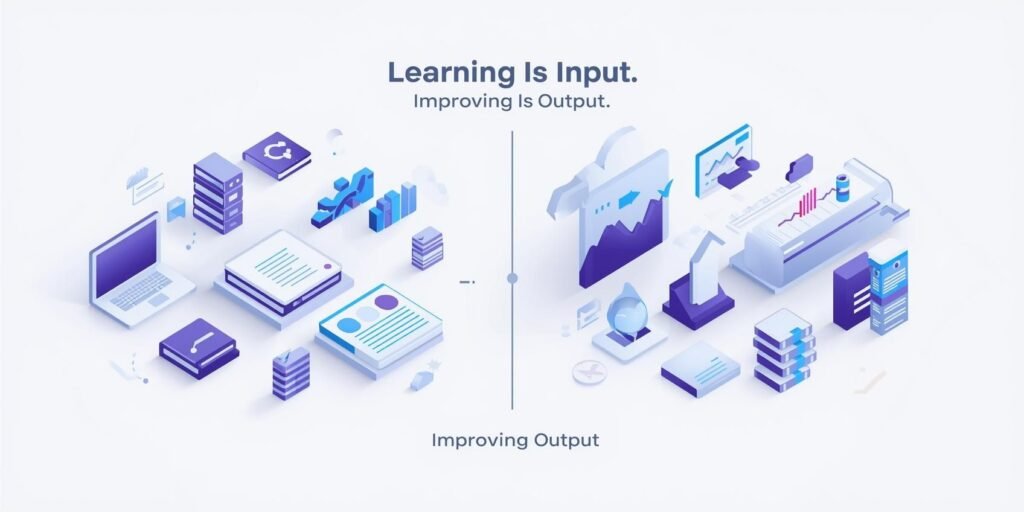
Here’s a simple test.
Ask yourself:
What can I do today that I couldn’t do 3 months ago?
What problems can I solve without help?
What have I built, fixed, shipped, or executed?
If the answer is unclear, then learning hasn’t converted into improvement.
Improvement always shows up as output:
Better decisions
Faster execution
Higher quality work
Reduced dependency on tutorials
Increased confidence in real scenarios
If output isn’t changing, input doesn’t matter.
Why AI Makes This Gap Even Bigger
AI has changed the rules completely.
AI can:
Explain concepts instantly
Generate code, content, designs
Summarize books and courses
Teach faster than any human
So if your “skill” is just knowing information or following steps, AI already does it better.
The only things that survive are:
Problem framing
Judgment
Contextual thinking
Tool mastery
Real-world execution
And none of these come from passive learning.
AI doesn’t replace learners.
It replaces people who never moved beyond learning.
How to Shift from Learning to Improving
If you want real growth, you need to change how you learn.
1. Learn Less. Apply More.
For every hour of learning, spend multiple hours applying it—without guidance.
2. Build Before You’re Ready
Stop waiting for confidence. Confidence comes after execution, not before.
3. Use Projects, Not Certificates
Projects expose gaps. Certificates hide them.
4. Measure Output, Not Consumption
Track what you’ve built, not what you’ve watched.
5. Get Comfortable Being Bad
Improvement starts where comfort ends. There’s no shortcut around this.
The ASI Gyan Perspective
At ASI Gyan, the focus is simple:
Stop consuming endlessly
Start building capability
Learn with intent, not habit
Improve through execution, not accumulation
Learning vs Improving.
Improving is rare.
That’s why improvement still matters.
Conclusion
Most people aren’t stuck because they lack resources.
They’re stuck because they confuse learning with progress.
In today’s world, information won’t set you apart.
Execution will.
So ask yourself honestly:
Are you Learning vs Improving…
or are you actually improving?