The workplace transformation driven by artificial intelligence is no longer a distant future scenario—it’s happening right now. As we navigate through 2026, the question on everyone’s mind isn’t whether AI on jobs, but rather how workers can adapt and thrive in this rapidly evolving landscape. Understanding which skills will be in demand is crucial for professionals, students, and organizations planning for the future.
Understanding the AI Revolution in the Workplace
Artificial intelligence has fundamentally altered how we work across virtually every industry. From healthcare diagnostics to financial analysis, from creative design to customer service, AI systems are augmenting human capabilities and, in some cases, replacing routine tasks entirely. However, this technological shift tells a more nuanced story than simple job displacement.
Recent data shows that while certain roles are being automated, the overall job market is experiencing a transformation rather than elimination. The impact of AI on employment has created new categories of work that didn’t exist five years ago, while simultaneously requiring existing workers to develop new competencies. Machine learning engineers, AI ethicists, and prompt engineers are just a few examples of roles that have emerged from this technological revolution.
Skills That Are Rising in Demand
Technical and Digital Literacy
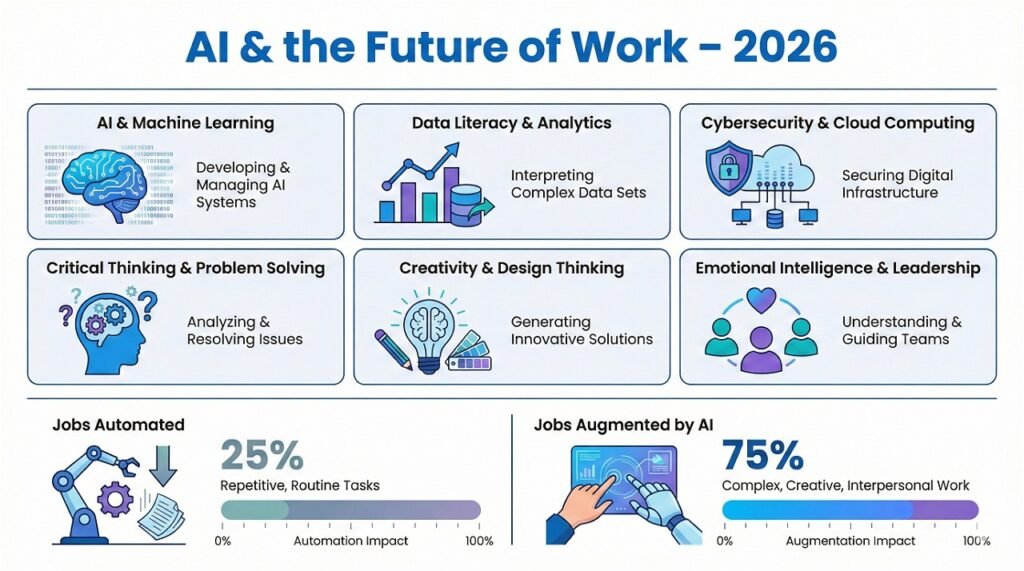
Perhaps unsurprisingly, AI-related skills top the list of in-demand competencies for 2026. However, you don’t need to be a computer scientist to remain relevant. Basic digital literacy and the ability to work alongside AI tools have become as essential as email proficiency was two decades ago. Workers who can effectively leverage AI assistants, understand data analytics basics, and navigate digital platforms are finding themselves with significant competitive advantages. This includes understanding how to prompt AI systems effectively, interpret their outputs critically, and integrate these tools into daily workflows. Automation skills and familiarity with no-code and low-code platforms have democratized technical capabilities, allowing professionals across disciplines to build solutions without extensive programming knowledge.
Critical Thinking and Complex Problem-Solving
As AI handles more routine cognitive tasks, human workers are increasingly valued for their ability to tackle complex problems that require nuanced judgment. Critical thinking skills have become paramount because machines, despite their computational power, still struggle with ambiguous situations that lack clear parameters.
The ability to ask the right questions, challenge assumptions, and synthesize information from multiple sources represents a distinctly human advantage. Employers are seeking professionals who can navigate gray areas, consider ethical implications, and make decisions that balance multiple competing priorities—areas where human judgment remains superior to algorithmic processing.
Emotional Intelligence and Human-Centric Skills
Ironically, as workplaces become more technologically advanced, emotional intelligence has emerged as one of the most valuable commodities. The ability to understand, empathize with, and effectively communicate with other humans cannot be replicated by AI systems, making these soft skills increasingly important.
Interpersonal skills, including active listening, conflict resolution, and team collaboration, are highly sought after in 2026. Customer-facing roles, leadership positions, and ai on jobs requiring negotiation or persuasion all depend on these fundamentally human capabilities. Organizations recognize that while AI can process customer inquiries, it cannot truly understand the emotional context or build the genuine relationships that drive loyalty and satisfaction.
Creativity and Innovation
Creative skills represent another domain where humans maintain a significant edge. While AI can generate content, images, and even music, truly innovative thinking—the kind that reimagines problems or creates entirely new categories—remains a human strength. The future of work demands professionals who can think beyond existing frameworks and develop original solutions.
This creativity extends beyond traditionally artistic fields. Creative problem-solving in business strategy, product development, and organizational design all require the kind of lateral thinking and intuitive leaps that AI systems cannot yet replicate. Professionals who can combine creative thinking with technical tools are particularly valuable, using AI as an amplifier for their imaginative capabilities rather than a replacement.
Adaptability and Continuous Learning
Perhaps the meta-skill of 2026 is the ability to learn continuously. Lifelong learning isn’t just a buzzword—it’s a survival requirement in a rapidly changing job market. The specific technical tools and platforms you master today may be obsolete tomorrow, but the capacity to quickly acquire new skills remains permanently valuable.
Workers who demonstrate adaptability and a growth mindset are thriving in this environment. This means being comfortable with ambiguity, willing to step outside comfort zones, and proactive about skill development. Organizations increasingly value employees who don’t wait for formal training programs but instead take initiative in their own professional development.
Industry-Specific Skill Demands
Different sectors are experiencing the AI transformation in unique ways, creating varied skill requirements across industries. In healthcare, the demand has surged for professionals who can bridge clinical expertise with data science, interpreting AI-generated diagnostics while providing compassionate patient care. The manufacturing sector seeks workers who understand both traditional production processes and smart factory technologies, requiring a blend of mechanical knowledge and digital capability.
Financial services need professionals skilled in AI ethics and regulatory compliance, ensuring algorithmic decision-making remains fair and transparent. Meanwhile, creative industries value those who can direct AI tools while maintaining artistic vision, using technology as a medium rather than a crutch. Education has seen explosive demand for instructional designers who can create engaging online learning experiences that incorporate AI-powered personalization while preserving the human connection essential to effective teaching.
Preparing for the AI-Driven Workplace
The key to remaining relevant in 2026’s job market isn’t trying to compete with AI at tasks it performs well, but rather focusing on distinctly human strengths while leveraging AI on jobs. This means developing a T-shaped skill set: deep expertise in one area combined with broad capabilities across multiple domains.
Practical steps include engaging with AI tools in your current role, seeking projects that stretch your capabilities, and pursuing both formal education and informal learning opportunities. Online courses, professional certifications, and hands-on experimentation all contribute to building relevant competencies. Networking remains crucial, as many opportunities arise through human connections rather than automated job matching systems. Building relationships with professionals across different fields exposes you to diverse perspectives and potential career paths you might not have considered.
The Human Element in an AI World
Despite anxiety about automation replacing jobs, the reality in 2026 is more balanced. Yes, certain roles have diminished or disappeared, but new opportunities have emerged, often offering more meaningful work by eliminating tedious tasks and allowing humans to focus on what we do best.
The most successful professionals are those who view AI as a collaborator rather than a competitor. They use technology to amplify their capabilities while doubling down on skills that machines cannot replicate: empathy, creativity, ethical reasoning, and the ability to navigate complex social dynamics.
Conclusion
The impact of artificial intelligence on jobs in 2026 is profound but not universally negative. While the workplace continues evolving at an unprecedented pace, opportunities abound for those willing to adapt. The skills most in demand—critical thinking, emotional intelligence, creativity, technical literacy, and continuous learning—represent a combination of timeless human strengths and modern technological competencies.
Rather than fearing obsolescence, workers should embrace this moment as an opportunity to develop more meaningful, human-centric skills while leveraging AI on jobs to eliminate mundane tasks. The future belongs not to those who resist change, but to those who thoughtfully integrate new tools while cultivating the irreplaceable capabilities that make us uniquely human. By focusing on these in-demand skills, professionals can not only survive but thrive in the AI-transformed workplace of 2026 and beyond.