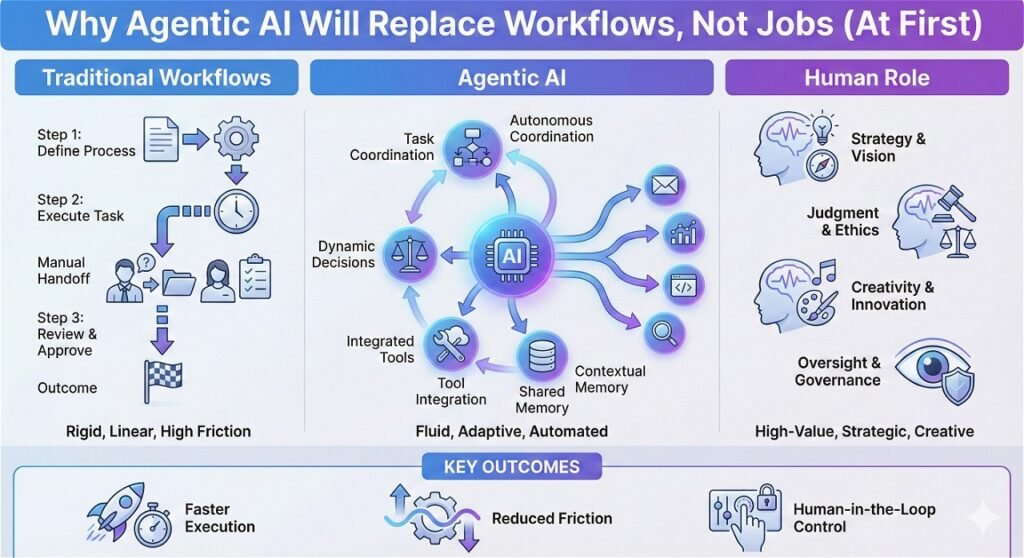
Discover how agentic AI transforms workflows without eliminating jobs. Learn why AI agents augment human work by automating tasks, not replacing people.
What Is Agentic AI and Why Does It Matter?
Agentic AI refers to autonomous artificial intelligence systems that can perceive their environment, make decisions, and take actions to achieve specific goals with minimal human intervention. Unlike traditional automation that follows rigid rules, agentic AI adapts, learns, and handles complex tasks across multiple systems. These AI agents represent the next evolution in workplace technology, designed to work alongside humans by taking over repetitive workflows while leaving strategic decision-making to people.
The workplace anxiety around artificial intelligence is understandable. Every technological leap brings fears of obsolescence, of machines rendering human contributions irrelevant. But the current wave of agentic AI tells a different story than the dystopian narratives suggest. Rather than replacing workers wholesale, these intelligent systems are quietly revolutionising how work gets done by targeting the invisible time-drains that plague modern professionals: endless email threads, data entry marathons, calendar Tetris, and the soul-crushing administrative tasks that keep us from actual thinking.
The Workflow Crisis Nobody Talks About
Before we discuss what agentic AI replaces, we need to acknowledge what’s broken. Knowledge workers today spend an estimated 60% of their time on “work about work” – coordinating, searching for information, switching between applications, and managing communication. That’s not a productivity problem. That’s a structural crisis.
Consider the typical marketing manager. Their day involves logging into twelve different SaaS tools, copying data between platforms, manually updating spreadsheets, scheduling meetings across time zones, following up on unanswered emails, and generating reports that synthesizer information from disparate sources. The actual creative strategy work? That happens in the margins, if there’s energy left.
This is where AI agents enter the picture, not as job terminators but as workflow eliminators.
How Agentic AI Targets Tasks, Not Roles
The crucial distinction is this: agentic AI excels at task-level automation within existing roles, not wholesale role replacement. An AI agent can monitor your inbox, identify action items, draft responses based on your communication style, and even coordinate meeting times with participants. But it doesn’t replace your judgement about which client relationships need personal attention or which strategic pivots make sense for your business.
These systems operate as intelligent , connecting your SaaS tools in ways that manual integrations never could. Where traditional automation required explicit programming for every scenario, AI agents can interpret context, handle exceptions, and adapt to new situations. They’re particularly effective at three categories of workflows:
Data synthesis and movement: AI agents can pull information from multiple sources, reconcile inconsistencies, and populate systems without manual data entry. That weekly sales report that took four hours? An agent handles it continuously in the background.
Communication triage and routing: Intelligent systems can categorise incoming requests, route them to appropriate team members, draft initial responses, and escalate issues that require human nuance. The administrative overhead of managing communication drops dramatically.
Process orchestration: Complex workflows involving multiple systems and approval chains become seamless. An AI agent can initiate processes, track progress, send reminders, and ensure nothing falls through the cracks without requiring constant human supervision.
The “At First” Caveat: Understanding the Timeline
The phrase “at first” in our title isn’t throwaway hedging. It’s an honest acknowledgement of trajectory. Agentic AI today is genuinely better at replacing workflows than jobs because the technology excels at bounded, repetitive tasks with clear inputs and outputs. The ambiguous, relationship-heavy, strategic elements of most jobs remain firmly in human territory.
But this technology improves exponentially, not linearly. As AI agents become more sophisticated, the line between “workflow automation” and “role automation” will blur. Some positions that are primarily about executing standardized workflows will inevitably consolidate. The difference is timeline and transition.
Right now, we’re in a golden period where artificial intelligence augments rather than replaces, where professionals who embrace these tools become significantly more productive while those who resist fall behind. Companies are implementing AI agents to handle the tedious 60% so their people can focus on the valuable 40%. That’s multiplication of human capability, not subtraction of human roles.
What This Means for Workers and Organisations
For individual professionals, the imperative is clear: focus on developing the skills that AI agents can’t easily replicate. Strategic thinking, relationship building, creative problem-solving, ethical judgement, and cross-functional collaboration become more valuable as routine execution becomes automated. The professionals who thrive will be those who learn to effectively delegate to AI agents while concentrating their human energy on high-impact activities.
Organisations face a more complex challenge. Implementing agentic AI isn’t just a technology deployment—it’s a workflow redesign project. Companies need to map their processes, identify automation opportunities, and importantly, help their workforce transition from task executors to strategic orchestra tors. The businesses that approach this as “technology plus training” will see productivity gains while maintaining morale. Those that treat it purely as a cost-cutting exercise will face resistance and turnover.
There’s also the critical question of what happens to the time reclaimed. If AI agents save each knowledge worker 24 hours per week, does that mean downsizing by 60%, or does it mean those same people can now tackle the perpetually under-resourced strategic initiatives that drive real business growth? Forward-thinking organisations are choosing the latter, redeploying human creativity to innovation rather than simply pocketing the efficiency gains.
The Path Forward: Augmentation Before Automation
The most likely scenario for the next five years isn’t mass unemployment from AI but a fundamental restructuring of how work flows through organisations. AI agents will handle the inter connective tissue of modern work—the status updates, data transfers, scheduling coordination, and routine communication—while humans focus on the decisions that require judgment, empathy, and strategic vision.
Job descriptions will evolve rather than disappear. The marketing manager still exists, but now they’re freed from the administrative morass to actually develop creative campaigns. The financial analyst still analyzes, but the data gathering and preliminary calculations happen automatically through intelligent agents. The customer success manager still builds relationships, but routine check-ins and issue tracking run in the background.
This transition requires intention. Workers need to actively cultivate their irreplaceably human skills. Organizations need to invest in both the technology and the human capacity building. Policymakers need to consider how to support workers through this transition period. Because while agentic AI might be replacing workflows rather than jobs today, the “at first” timeline is shorter than most people assume.
The question isn’t whether AI agents will transform work—they already are. The question is whether we’ll use this transformation to liberate human potential or simply to cut costs. The technology enables both paths. Which one we take is still up to us.
The bottom lin
Agentic AI represents the most significant workplace transformation since the internet, but its immediate impact is liberating professionals from workflow drudgery rather than eliminating their roles entirely. The winners in this transition will be those who embrace AI agents as collaborative tools while doubling down on distinctly human capabilities. The window for this relatively gentle transition won’t stay open forever, but for now, the robots aren’t taking your job—they’re just handling your busywork.