
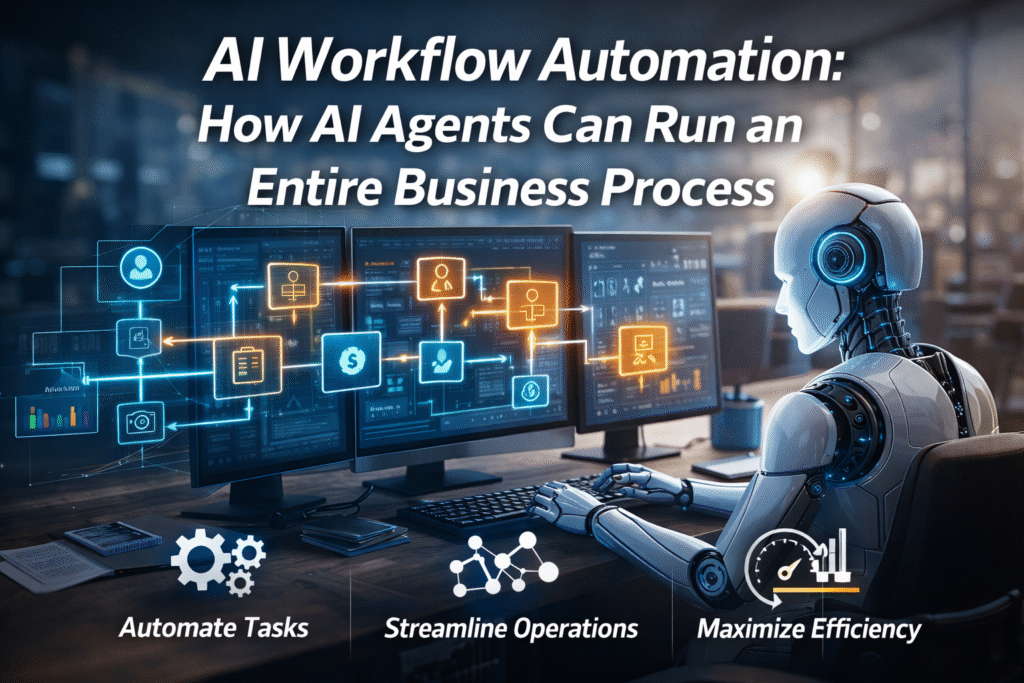
In today’s fast-paced digital landscape, businesses are constantly seeking ways to optimize operations, reduce costs, and improve efficiency. Enter AI workflow automation—a revolutionary approach that leverages AI agents to handle complex business processes from start to finish. This technology is transforming how organizations operate, enabling them to automate repetitive tasks, make intelligent decisions, and scale operations without proportional increases in human resources.
What is AI Workflow Automation?
AI workflow automation combines artificial intelligence with traditional workflow automation to create intelligent systems capable of managing entire business processes autonomously. Unlike conventional automation that follows rigid, pre-programmed rules, AI-powered automation can learn, adapt, and make decisions based on data patterns and contextual understanding.
AI agents are autonomous software programs that can perceive their environment, process information, make decisions, and take actions to achieve specific goals. When deployed in business process automation, these agents can handle everything from customer inquiries and data entry to complex decision-making and strategic planning.
How AI Agents Transform Business Processes
Intelligent Decision-Making
Traditional automation systems can only execute predefined rules, but AI agents bring machine learning and natural language processing capabilities to the table. These agents can analyze vast amounts of data, identify patterns, and make informed decisions without human intervention. For instance, an AI agent managing inventory can predict demand fluctuations, automatically reorder supplies, and optimize stock levels based on historical data and market trends.
End-to-End Process Management
AI workflow automation enables businesses to automate entire processes rather than just individual tasks. Consider customer onboarding: an AI agent can verify documents using optical character recognition (OCR), conduct background checks, process applications, send personalized communications, and update multiple systems—all without human touch points. This end-to-end automation reduces processing time from days to minutes.
Adaptive Learning and Continuous Improvement
One of the most powerful features of AI agents is their ability to learn from experience. Through machine learning algorithms, these systems continuously improve their performance. They analyze outcomes, identify what works best, and refine their approaches over time. This means your automated workflows become more efficient and accurate as they process more data.
Key Applications of AI Workflow Automation
Customer Service and Support
AI chatbots and virtual assistants have evolved far beyond simple FAQ responders. Modern AI agents can handle complex customer inquiries, troubleshoot issues, process returns, and even upsell products based on customer behavior analysis. They integrate with CRM systems, knowledge bases, and transaction platforms to provide comprehensive support 24/7.
Financial Operations
In finance departments, AI workflow automation is revolutionizing accounts payable, receivable, and reconciliation processes. AI agents can extract data from invoices, match purchase orders, detect fraud, process payments, and generate financial reports. This intelligent automation reduces errors, speeds up month-end closings, and ensures regulatory compliance.
Human Resources Management
From recruitment to employee onboarding and performance management, AI agents are streamlining HR processes. They can screen resumes, schedule interviews, conduct initial candidate assessments, manage employee documentation, and even provide personalized learning recommendations. This allows HR professionals to focus on strategic initiatives rather than administrative tasks.
Supply Chain and Logistics
AI-powered automation in supply chain management can predict demand, optimize routes, manage warehouse operations, and coordinate with suppliers. AI agents process real-time data from multiple sources to make dynamic decisions that minimize costs and maximize efficiency throughout the supply chain.
Marketing and Sales
AI workflow automation enables personalized marketing at scale. AI agents can segment audiences, create targeted campaigns, nurture leads, score prospects, and hand off qualified opportunities to sales teams at the optimal moment. They analyze customer behavior, predict churn, and recommend next-best actions to maximize conversion rates.
Benefits of Implementing AI Workflow Automation
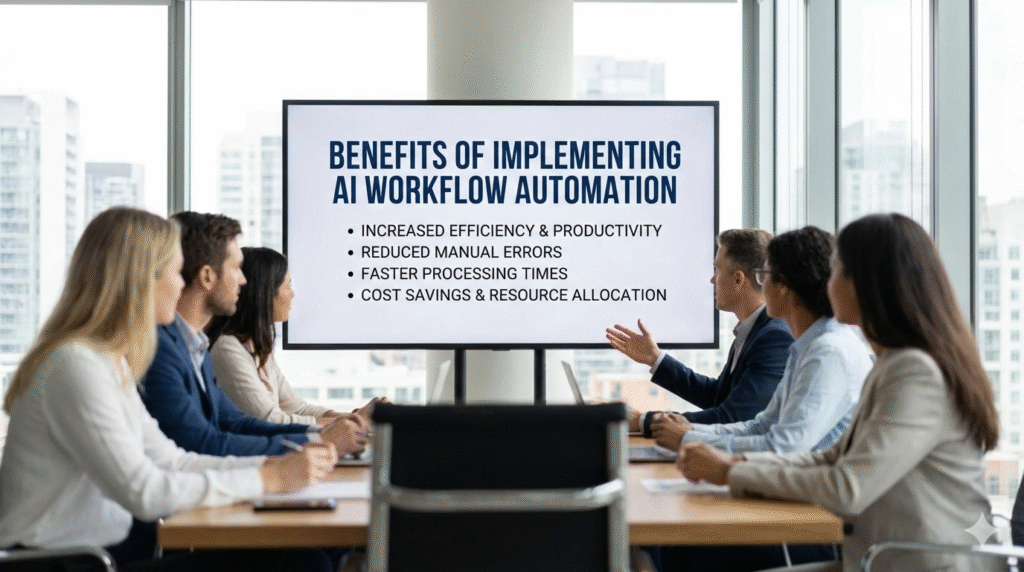
Increased Productivity and Efficiency
By automating repetitive and time-consuming tasks, AI agents free up employees to focus on high-value activities that require creativity, emotional intelligence, and strategic thinking. Organizations report productivity increases of 30-50% after implementing AI workflow automation solutions.
Cost Reduction
Intelligent automation significantly reduces operational costs by minimizing manual labor, reducing errors, and optimizing resource allocation. While there’s an initial investment in implementation, most businesses see ROI within 12-18 months.
Enhanced Accuracy and Compliance
Human error in data entry, processing, and decision-making can be costly. AI agents perform tasks with consistent accuracy, following compliance rules meticulously. They maintain detailed audit trails and can flag anomalies that might indicate fraud or regulatory issues.
Scalability Without Proportional Costs
Traditional scaling requires hiring more staff and expanding infrastructure. With AI workflow automation, businesses can handle increased volume without proportionally increasing costs. AI agents can process thousands of transactions simultaneously, making growth more sustainable.
Improved Customer Experience
AI-powered automation enables faster response times, personalized interactions, and 24/7 availability. Customers receive consistent, high-quality service regardless of when they engage with your business.
Implementing AI Workflow Automation: Best Practices
Start with High-Impact, Low-Complexity Processes
Begin your AI automation journey by identifying processes that are repetitive, rule-based, and high-volume. These provide quick wins and help build organizational confidence in the technology.
Ensure Data Quality and Integration
AI agents are only as good as the data they work with. Invest in data integration and cleaning to ensure your AI systems have access to accurate, comprehensive information across all relevant platforms.
Design for Human-AI Collaboration
The most successful implementations view AI workflow automation as augmenting human capabilities rather than replacing them entirely. Design workflows where AI agents handle routine tasks while humans focus on exceptions, strategy, and relationship-building.
Monitor, Measure, and Optimize
Establish clear KPIs to measure the performance of your automated workflows. Use analytics and reporting tools to track metrics like processing time, error rates, cost savings, and customer satisfaction. Continuously refine your AI systems based on these insights.
Prioritize Security and Privacy
When implementing AI agents that handle sensitive data, ensure robust security measures are in place. This includes encryption, access controls, and compliance with regulations like GDPR and CCPA.
The Future of AI Workflow Automation
The evolution of AI workflow automation is accelerating. Emerging technologies like generative AI, advanced natural language processing, and computer vision are expanding what AI agents can accomplish. We’re moving toward truly autonomous business processes where AI agents can handle complex negotiations, creative tasks, and strategic planning.
Hyperautomation—the orchestration of multiple automation technologies including AI, RPA, and process mining—represents the next frontier. This approach creates intelligent business ecosystems where different AI agents collaborate seamlessly across departments and even between organizations.
Conclusion
AI workflow automation is no longer a futuristic concept—it’s a present-day reality transforming how businesses operate. By deploying AI agents to manage entire business processes, organizations can achieve unprecedented levels of efficiency, accuracy, and scalability. Whether you’re looking to streamline customer service, optimize financial operations, or revolutionize your supply chain, AI-powered automation offers the tools to make it happen.
The key to success lies in strategic implementation: start with clear objectives, ensure quality data, design for human-AI collaboration, and continuously optimize your systems. As AI technology continues to evolve, businesses that embrace AI workflow automation today will be best positioned to thrive in tomorrow’s increasingly competitive landscape.
