What Is Agentic AI? A Direct Definition
Agentic AI refers to artificial intelligence systems that operate with autonomy, making independent decisions and taking actions to achieve defined goals without constant human intervention. Unlike traditional automation that follows predetermined rules, agentic AI adapts to changing circumstances, learns from context, and exercises judgment to complete complex tasks—functioning more like a trusted colleague than a programmed script. For decades, businesses have pursued automation as the holy grail of efficiency. We’ve automated email responses, manufacturing processes, data entry, and countless repetitive tasks. The promise was simple: eliminate human effort, reduce errors, and accelerate operations. But here’s what we’ve learned—automation only works when the path forward is completely predictable.
Enter agentic AI, a fundamentally different paradigm that’s reshaping how we think about machine intelligence in the workplace. This isn’t about creating more sophisticated if-then statements or elaborate decision trees. It’s about building AI agents that can think, adapt, and act independently within defined boundaries—systems you delegate to, not just automate with.
The Critical Distinction: Automation vs. AI Agents
Traditional automation operates on rigid, predefined pathways. Consider an automated email responder: it detects specific keywords and sends templated replies. There’s no understanding, no context evaluation, no adaptation. The moment a situation deviates from its programming, automation fails spectacularly or proceeds blindly with inappropriate actions.
AI agents in business function entirely differently. They possess the ability to understand context, evaluate multiple variables, make judgment calls, and adjust their approach based on outcomes. When you delegate a task to an agentic AI system, you’re providing objectives and constraints, then trusting the agent to determine the optimal path to achieve those goals.
Think about the difference between setting up an automated calendar reminder versus delegating meeting coordination to an AI agent. The automation will ping you at predetermined times. The agent, however, can analyze your schedule patterns, understand meeting priorities based on email content and participant seniority, negotiate timing with other parties, reschedule when conflicts arise, and even prepare relevant briefing materials —all without your direct involvement in each decision.
How AI Decision-Making Systems Actually Work
The power of agentic AI lies in its sophisticated decision-making architecture. These systems combine several advanced capabilities that set them apart from conventional automation:
Contextual Understanding: AI agents process natural language, interpret nuanced situations, and grasp the broader context of their tasks. They don’t just match patterns; they comprehend meaning and implications.
Goal-Oriented Reasoning: Rather than following step-by-step instructions, these systems work backward from desired outcomes. They evaluate multiple potential approaches, anticipate obstacles, and chart courses of action that maximize success probability.
Adaptive Learning: Through interaction and feedback, AI decision-making systems refine their approaches over time. They recognize what worked, what didn’t, and adjust their strategies accordingly—without requiring manual reprogramming.
Multi-Step Planning: Agentic AI can decompose complex objectives into sequential sub-tasks, execute them in logical order, and pivot when circumstances change. This planning capability mirrors how experienced professionals approach sophisticated projects.
Tool Integration: Modern AI agents can interact with multiple software systems, APIs, and data sources to gather information and execute actions—effectively using your existing technology stack as their toolkit.
Real-World Applications: Where Delegation Outperforms Automation

The distinction between AI agents vs automation becomes crystal clear when examining practical implementations across industries. In customer service, traditional automation offered chatbots with scripted responses and rigid decision trees. They frustrate customers the moment queries fall outside narrow parameters. Agentic AI customer service agents, by contrast, can understand complex complaints, research account history across multiple systems, determine appropriate resolutions based on customer value and issue severity, and even escalate to humans when situations require empathy or authority they cannot provide.
Software development teams are deploying AI agents that don’t just autocomplete code but actively debug issues, suggest architectural improvements, write test coverage, and even review pull requests with contextual understanding of project requirements and coding standards. These agents collaborate with human developers rather than simply executing predetermined scripts. In financial operations, AI agents analyze market conditions, portfolio performance, and risk factors to make trading decisions or rebalance investments within parameters set by human strategists. They respond to breaking news, correlation changes, and volatility spikes in ways that static algorithms cannot.
Marketing teams leverage AI agents that monitor campaign performance, identify underperforming segments, reallocate budget across channels, and generate content variations for A/B testing—all while adapting to realtime engagement signals and competitive landscape shifts.
The Trust Factor: Why Delegation Requires Different Thinking
Automation is comfortable because it’s predictable. We know exactly what automated systems will do because we programmed every contingency. Delegation to AI agents requires a fundamentally different relationship with technology—one built on trust, boundaries, and ongoing supervision.
This doesn’t mean blind faith in machines. Rather, it means establishing clear guardrails: defining the scope of autonomous decision-making, setting thresholds for human escalation, implementing oversight mechanisms, and maintaining audit trails of agent actions. Organizations succeeding with agentic AI adopt a collaborative mindset. They position AI agents as junior team members with specific expertise and capabilities, requiring training, feedback, and gradual expansion of responsibilities as they prove reliable. The question isn’t whether these agents will occasionally make mistakes—they will, just as human employees do. The question is whether their overall contribution exceeds the cost of supervision and occasional error correction. For most knowledge work and operational tasks, that threshold has already been crossed.
The Future of Work: Humans and AI Agents Together
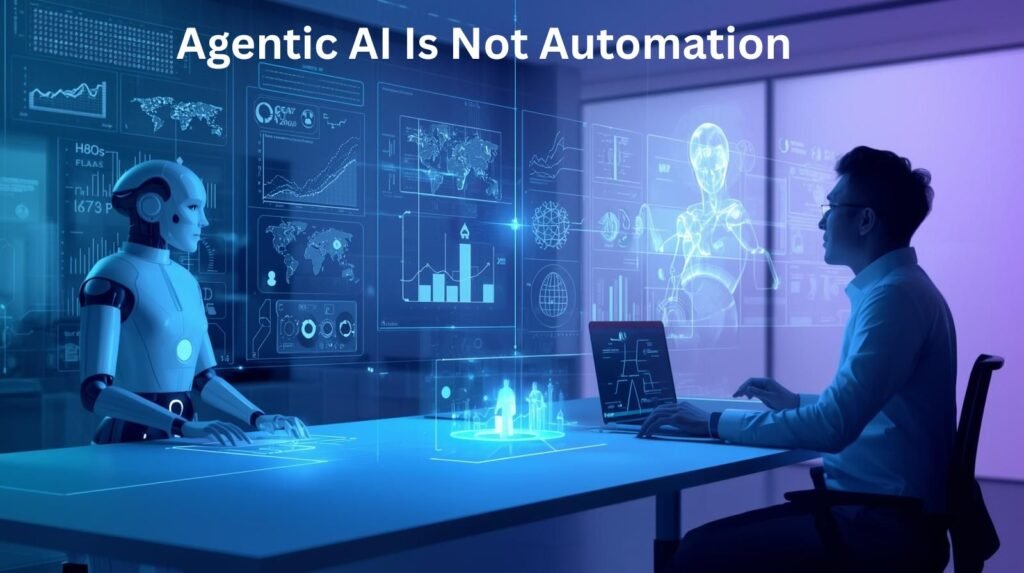
As AI agents in business become more sophisticated, we’re witnessing the emergence of human-AI teams where both parties contribute their unique strengths. Humans provide strategic vision, ethical judgment, creative insight, and relationship management. AI agents contribute tireless analysis, rapid execution, perfect memory, and consistent application of learned patterns. This isn’t about replacement—it’s about elevation. When you delegate routine decision-making and execution to capable AI agents, you free human talent for higher-order thinking, complex problem-solving, and work that requires genuine creativity or emotional intelligence. The organizations that will thrive in this new landscape are those that recognize agentic AI not as glorified automation, but as the beginning of genuine human-machine collaboration. They’re rethinking workflows, redesigning roles, and cultivating the management skills necessary to lead teams that include both carbon and silicon-based intelligence.
Making the Shift: From Automation to Delegation
For business leaders considering this transition, the path forward begins with identifying tasks currently handled through either manual labor or brittle automation—tasks that require contextual judgment but follow recognizable patterns. These are prime candidates for AI agent delegation.
Start small with well-defined domains where mistakes have limited consequences and success is measurable. Deploy AI agents with clear objectives, appropriate constraints, and robust monitoring. Gather feedback from both the agents’ actions and the humans who interact with their output.
As competence builds and trust develops, gradually expand the scope of delegation. The goal isn’t to eliminate human involvement but to shift it toward oversight, exception handling, and continuous improvement of the agent’s capabilities and boundaries. The future of work isn’t about building more sophisticated automation. It’s about creating agentic AI capable enough to be worthy of delegation—and having the wisdom to deploy them effectively. Those who grasp this distinction will find themselves leading organizations that operate