- Understanding the Core: Difference Between AI, Machine Learning & Deep Learning
- Conclusion: Navigating the AI Revolution
Artificial intelligence is no longer a futuristic concept—it’s transforming industries, reshaping careers, and redefining how businesses operate in India and globally. Yet, many professionals and students still struggle to understand the Difference Between AI, Machine Learning & Deep Learning. While these terms are often used interchangeably, they represent distinct concepts with unique applications and capabilities. This comprehensive guide breaks down these technologies, explores their real-world applications, and provides actionable insights for leveraging them in 2026 and beyond.
Understanding the Core: Difference Between AI, Machine Learning & Deep Learning
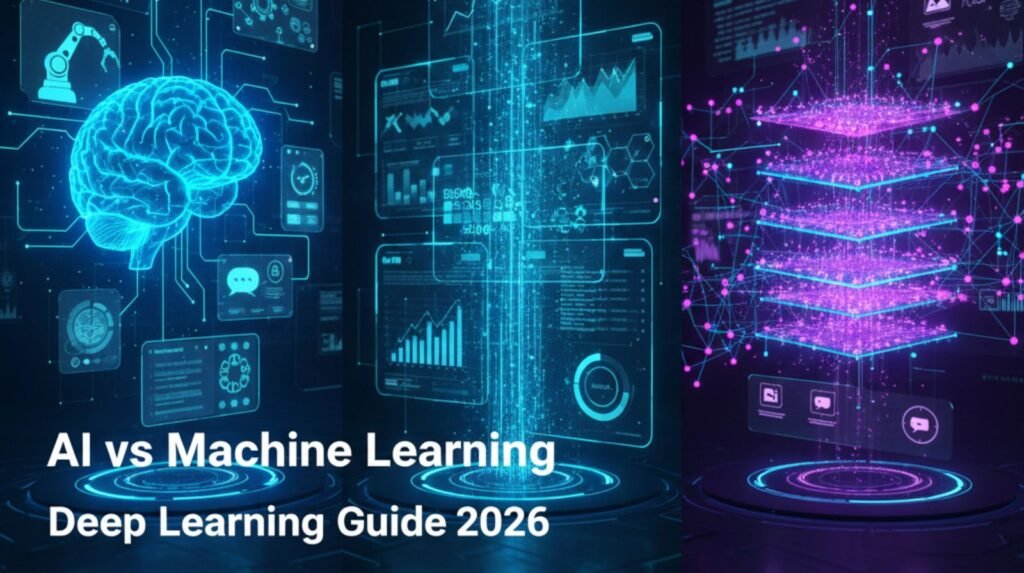
To grasp the Difference Between AI, Machine Learning & Deep Learning, think of them as nested concepts—each building upon the previous one.
Artificial Intelligence (AI) is the broadest concept, referring to any technique that enables machines to mimic human intelligence. This includes problem-solving, decision-making, language understanding, and pattern recognition.
Machine Learning (ML) is a subset of AI that focuses on algorithms learning from data without explicit programming. Instead of following predetermined rules, ML systems improve their performance through experience.
Deep Learning (DL) is a specialized subset of machine learning that uses neural networks with multiple layers to process complex patterns in large datasets.
The relationship is hierarchical: Deep Learning sits within Machine Learning, which sits within Artificial Intelligence.
Artificial Intelligence Explained: The Foundation of Smart Systems
Artificial intelligence encompasses any computational system designed to perform tasks that typically require human intelligence. AI technologies explained include:
- Rule-based systems that follow predefined logic
- Expert systems that replicate human decision-making
- Natural language processing for understanding human communication
- Computer vision for interpreting visual information
- Robotics and autonomous systems
AI Technologies in India’s Digital Transformation
India has emerged as a major AI adoption hub in 2026. The government’s National AI Portal and initiatives like AI for All have accelerated implementation across sectors. From NITI Aayog’s AI strategy to startups leveraging AI for vernacular language processing, the country is experiencing unprecedented technological growth.
Applications of AI in business are visible everywhere—from chatbots handling customer service for Indian e-commerce platforms like Flipkart and Amazon India to AI-powered fraud detection in banking systems at ICICI and HDFC Bank.
Machine Learning: Where Systems Learn from Experience
The artificial intelligence vs machine learning distinction becomes clearer when we examine how ML systems function. Unlike traditional AI that relies on explicit programming, machine learning algorithms identify patterns in data and make predictions or decisions based on those patterns.
Types of Machine Learning
Supervised Learning: Systems learn from labeled data to make predictions. For example, Indian fintech company Paytm uses supervised learning to assess credit risk for loan approvals.
Unsupervised Learning: Algorithms find hidden patterns in unlabeled data. Retailers like BigBasket use this for customer segmentation and personalized recommendations.
Reinforcement Learning: Systems learn through trial and error, receiving rewards for correct actions. This powers autonomous delivery robots being tested in Bengaluru and Gurugram.
Deep Learning vs Machine Learning: What Sets Them Apart
The deep learning vs machine learning comparison reveals significant differences in approach and capability:
Data Requirements: Traditional machine learning can work with smaller datasets (thousands of examples), while deep learning requires massive amounts of data (millions of examples) to perform effectively.
Feature Engineering: Machine learning often requires human experts to manually select which features are important. Deep learning automatically discovers relevant features through neural networks in deep learning.
Computational Power: Machine learning algorithms can run on standard computers, while deep learning demands powerful GPUs or specialized processors.
Accuracy: For complex tasks like image recognition or natural language understanding, deep learning typically achieves superior accuracy compared to traditional machine learning approaches.
Neural Networks in Deep Learning: The Brain-Inspired Architecture
Neural networks in deep learning are inspired by the human brain’s structure. These networks consist of interconnected layers of nodes (neurons) that process information hierarchically.
How Deep Neural Networks Function
Input Layer: Receives raw data (images, text, audio)
Hidden Layers: Multiple layers extract increasingly complex features. Early layers might detect edges in images, while deeper layers recognize entire objects.
Output Layer: Produces the final prediction or classification
Indian healthtech companies like Practo and 1mg use deep learning neural networks to analyze medical images, helping radiologists detect abnormalities in X-rays and CT scans with remarkable accuracy.
Real-World Applications: AI, ML, and DL in Action
Applications of AI in Business Across India
Banking and Finance: HDFC Bank’s AI-powered virtual assistant EVA handles millions of customer queries. State Bank of India uses machine learning for predictive analytics in loan processing.
Healthcare: Apollo Hospitals employs AI diagnostic tools that analyze patient data and medical images. Deep learning algorithms assist doctors in early cancer detection.
Agriculture: AI-powered apps like Microsoft’s AI for Earth help farmers in rural India optimize crop yields through weather prediction and soil analysis.
E-commerce: Flipkart and Myntra use recommendation engines powered by machine learning to personalize shopping experiences for millions of Indian consumers.
Manufacturing: Tata Motors and Mahindra leverage AI for predictive maintenance, reducing downtime and improving production efficiency.
The Future of AI in 2026 and Beyond
The future of AI in 2026 is characterized by several transformative trends:
Generative AI Integration: Tools like ChatGPT and Google’s Gemini are being integrated into everyday business workflows, automating content creation, code generation, and customer service.
Edge AI: Processing AI algorithms directly on devices rather than cloud servers, enabling faster responses and better privacy—crucial for India’s growing IoT ecosystem.
Explainable AI: As AI systems make critical decisions in healthcare and finance, transparency and interpretability become essential regulatory requirements.
AI Democratization: Low-code and no-code AI platforms are making these technologies accessible to small businesses and startups across tier-2 and tier-3 Indian cities.
Quantum AI: The intersection of quantum computing and AI promises to solve complex problems in drug discovery, climate modeling, and financial optimization.
Actionable Insights for Students and Professionals
For Students
Develop foundational skills in Python programming and statistics. Platforms like NPTEL, Coursera, and IIT-backed programs offer excellent AI and ML courses. Focus on practical projects using real datasets to build a strong portfolio.
For Business Professionals
Start small with AI adoption—identify specific pain points where AI can deliver measurable ROI. Invest in upskilling your workforce through corporate training programs. Partner with Indian AI startups and service providers who understand local market dynamics.
For Entrepreneurs
Explore sector-specific AI applications relevant to India’s unique challenges—financial inclusion, agricultural productivity, healthcare accessibility, or education quality. Government initiatives like Startup India offer support for AI-focused ventures.
Conclusion: Navigating the AI Revolution
Understanding the Difference Between AI, Machine Learning & Deep Learning is no longer optional—it’s essential for anyone looking to thrive in 2026’s technology-driven economy. While AI represents the broad vision of intelligent machines, machine learning provides the methods for systems to learn from data, and deep learning offers the sophisticated neural architectures for tackling complex challenges.
India stands at an inflection point in AI adoption, with opportunities spanning every sector from agriculture to aerospace. The applications of AI in business will only expand as computational power increases and algorithms become more sophisticated. The future of AI in 2026 belongs to those who not only understand these technologies but actively implement them to solve real-world problems.
Take Action Today: Whether you’re a student, professional, or entrepreneur, start your AI journey now. Enroll in an online course, experiment with open-source ML libraries like TensorFlow and PyTorch, or identify one area in your business where AI could drive efficiency. The Difference Between AI, Machine Learning & Deep Learning may seem complex, but mastering these concepts will position you at the forefront of India’s digital transformation.