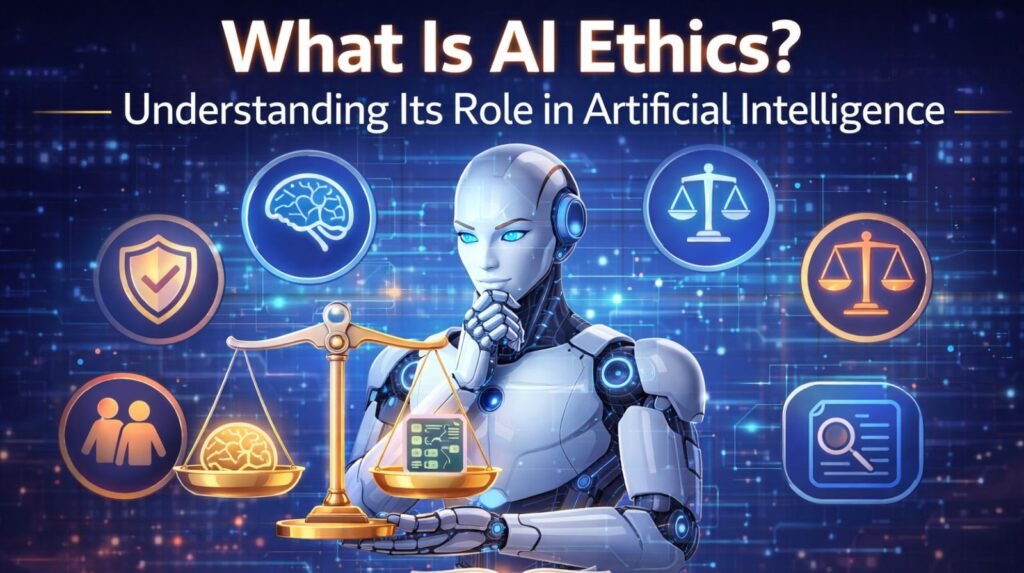
What Is AI Ethics?
AI ethics refers to the moral principles and guidelines that govern how artificial intelligence systems are designed, developed, and used responsibly. It ensures that AI technologies are fair, transparent, accountable, and safe for individuals and society.
In simple terms, AI ethics is about making sure that intelligent systems behave in a way that benefits humans rather than harming them.
Introduction: Why AI Ethics Matters Today
Artificial Intelligence is no longer a futuristic concept—it’s already embedded in our daily lives. From recommendation systems and chatbots to self-driving cars and fraud detection, AI is making decisions that directly impact people.
But here’s the problem:
AI systems are only as good as the data and logic behind them.
Without AI ethics, these systems can:
- Reinforce bias
- Violate privacy
- Make unfair decisions
- Operate without accountability
That’s why ethical AI is not optional anymore—it’s a necessity.
Why Is AI Ethics Important?
The importance of AI ethics lies in its ability to ensure that AI systems are used responsibly and do not cause harm.
🔹 1. Prevents Bias and Discrimination
AI systems learn from historical data. If that data contains bias, the system will replicate it.
👉 Example: A hiring AI trained on biased data may prefer male candidates over female ones.
This is where AI bias becomes a serious issue, and ethical AI practices are needed to correct it.
🔹 2. Protects User Privacy
AI systems rely heavily on data—often personal and sensitive.
Without proper AI governance, user data can be misused, leading to:
- Data leaks
- Surveillance
- Unauthorized access
Responsible AI ensures that data is collected and used ethically.
🔹 3. Builds Trust in AI Systems
If users don’t understand how AI works, they won’t trust it.
AI transparency plays a key role here. Systems must be explainable so users can trust decisions made by AI.
🔹 4. Ensures Accountability
When an AI system makes a mistake, who is responsible?
AI ethics ensures that accountability is clearly defined—whether it’s the developer, organization, or system owner.
🔹 5. Supports Legal Compliance
Governments around the world are introducing regulations for AI.
Following AI governance frameworks helps companies avoid legal risks and penalties.
Key Principles of AI Ethics
To implement ethical AI, certain core principles must be followed:
✔️ 1. Fairness
AI systems must treat all individuals equally and avoid discrimination.
This is critical in preventing AI bias in areas like hiring, lending, and law enforcement.
✔️ 2. Transparency
Users should understand how AI systems make decisions.
Lack of AI transparency leads to distrust and potential misuse.
✔️ 3. Accountability
Organizations must take responsibility for the outcomes of their AI systems.
Without accountability, responsible AI cannot exist.
✔️ 4. Privacy and Data Protection
AI systems must respect user privacy and ensure secure data handling.
This is a key component of AI governance.
✔️ 5. Safety and Reliability
AI systems should function consistently and avoid harmful outcomes.
Unreliable systems can cause serious real-world damage.
✔️ 6. Human Oversight
Humans must remain in control of AI decisions, especially in critical areas.
This ensures that ethical AI aligns with human values.
Real-World Examples of AI Ethics Issues
Understanding AI ethics becomes easier when we look at real-world failures.
🔴 1. Facial Recognition Bias
Facial recognition systems have shown higher error rates for darker skin tones.
This highlights the dangers of AI bias and lack of diverse training data.
🔴 2. Biased Hiring Algorithms
A well-known case involved an AI hiring tool that favored male candidates.
The system learned from historical hiring data, reinforcing gender bias.
🔴 3. Social Media Algorithms
AI algorithms often prioritize engagement over truth.
This leads to:
- Spread of misinformation
- Echo chambers
- Social polarization
This raises serious concerns about responsible AI.
🔴 4. Credit Scoring Systems
AI used in financial services may unfairly reject individuals from certain demographics.
This shows how lack of AI ethics can lead to economic inequality.
The Role of Ethics in AI Development
Ethics must be integrated into every stage of AI development—not added later.
🔹 1. Data Collection
- Use diverse and unbiased datasets
- Avoid incomplete or skewed data
This reduces AI bias from the start.
🔹 2. Model Training
- Apply fairness checks
- Use bias detection tools
This ensures ethical AI systems are trained responsibly.
🔹 3. Deployment
- Monitor system behavior in real-world conditions
- Identify unintended consequences
This strengthens AI governance.
🔹 4. Continuous Monitoring
- Regular audits
- Feedback loops
- System updates
This keeps responsible AI aligned with changing environments.
Challenges in Implementing AI Ethics
Despite its importance, implementing AI ethics is not easy.
❌ 1. Bias Is Hard to Eliminate
Even with best efforts, completely removing AI bias is extremely difficult.
❌ 2. Lack of Transparency
Many advanced models (like deep learning) are hard to explain.
This makes AI transparency a challenge.
❌ 3. Conflicting Business Interests
Companies often prioritize profit over ethical AI practices.
❌ 4. Lack of Standard Regulations
Different countries have different rules, making AI governance complex.
❌ 5. Technical Limitations
Building fully explainable and fair AI systems is still an evolving field.
Future of AI Ethic
The future of AI ethics will shape how technology evolves.
🔹 Increasing Regulations
Governments are introducing stricter AI laws and compliance requirements.
🔹 Rise of Explainable AI (XAI)
There will be more focus on AI transparency and explainability.
🔹 Ethical AI as a Competitive Advantage
Companies adopting responsible AI will gain more trust and credibility.
🔹 AI Audits and Certifications
Organizations may need to prove compliance with AI governance standards.
🔹 Human-Centric AI
Future AI systems will prioritize human well-being over automation efficiency.