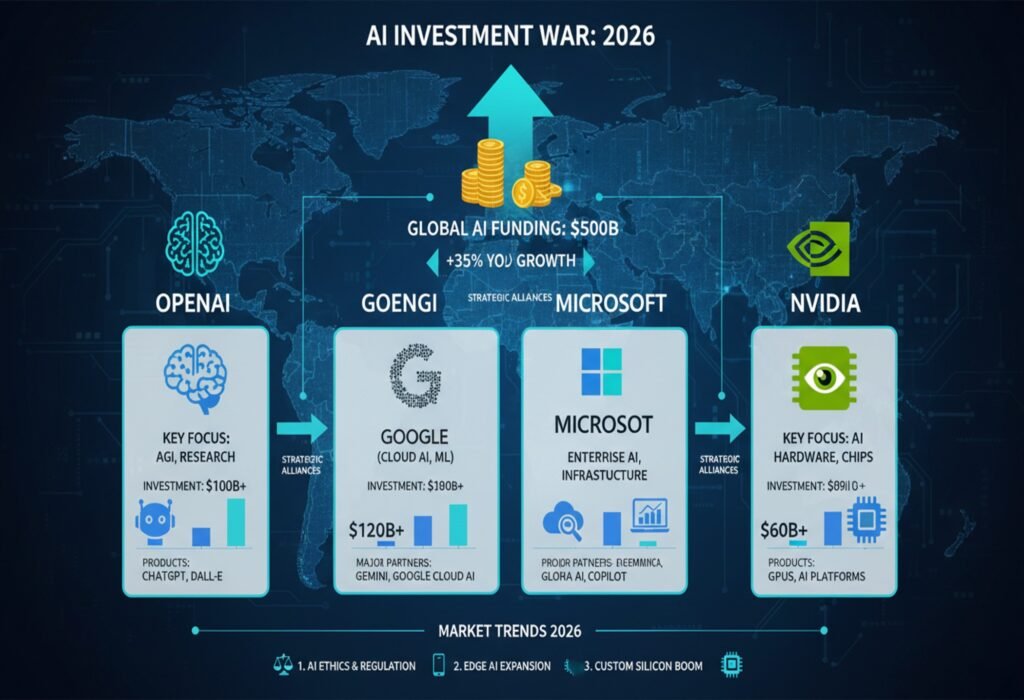
The recent announcement of OpenAI Raises $4 Billion in funding has sent shockwaves through the technology landscape, reshaping the global AI industry. This substantial investment is not just a financial milestone for OpenAI; it represents a critical juncture in the ongoing AI investment war among tech giants. Companies like Google, Microsoft, Anthropic, and Nvidia are now vying for dominance in a rapidly evolving market. This blog will explore how this funding round is influencing enterprise AI adoption, startup dynamics, and the broader AI infrastructure landscape as we move into 2026.
Introduction
In 2026, the competition for supremacy in artificial intelligence has intensified dramatically. OpenAI’s latest funding round is a key player in this shift, driving new innovations and strategies among leading tech firms. Businesses using AI investment strategies gain a competitive edge by leveraging advanced technologies to enhance productivity and efficiency. As the AI landscape evolves, understanding these dynamics becomes essential for SMEs and stakeholders in the tech industry.
Understanding the AI Investment War
The AI investment war is characterized by aggressive funding rounds and strategic partnerships among major players. OpenAI’s recent influx of capital is indicative of a broader trend where companies are racing to secure resources that enable them to innovate faster and more effectively. Recent data shows that in 2026, venture capitalists are increasingly favoring AI startups, with investments reaching unprecedented levels.
Key Players in the AI Investment War
- OpenAI: With its substantial funding, OpenAI is poised to expand its research and development capabilities.
- Google: Known for its extensive AI portfolio, Google is doubling down on investments to enhance its AI offerings.
- Microsoft: A significant partner of OpenAI, Microsoft is leveraging its cloud infrastructure to support AI innovations.
- Anthropic: This emerging player focuses on safety in AI, attracting investments aimed at responsible AI development.
- Nvidia: As a leader in AI hardware, Nvidia’s role is crucial in providing the necessary infrastructure for AI advancements.
Businesses utilizing the future of AI startups are likely to witness accelerated growth as these companies push the boundaries of technology.
The Role of Venture Capital
Venture capital plays a pivotal role in the AI investment war, with firms increasingly willing to invest large sums into promising AI technologies. In 2026, many businesses report that the competition for funding is fierce, leading to inflated valuations for AI startups. This trend is reshaping the landscape, making it essential for companies to differentiate themselves through innovative solutions and strategic partnerships.
OpenAI’s $4 Billion Funding Round
OpenAI Raises $4 Billion funding round marks a significant milestone in the AI industry. This capital infusion is expected to fuel research initiatives, enhance product offerings, and expand market reach. With this funding, OpenAI aims to solidify its position as a leader in the AI space while driving advancements that can benefit various sectors.
Strategic Goals of OpenAI
- Research and Development: The funding will support cutting-edge research in machine learning and natural language processing.
- Product Expansion: OpenAI plans to broaden its product portfolio, including new AI tools and services tailored for businesses.
- Global Partnerships: Collaborations with other tech giants and academic institutions will be prioritized to foster innovation.
Businesses leveraging enterprise AI solutions are likely to benefit from the advancements driven by OpenAI’s funding.
Implications for the AI Ecosystem
The implications of OpenAI’s funding extend beyond the company itself. As OpenAI pushes forward, competitors are compelled to enhance their offerings, resulting in a ripple effect throughout the industry. This competitive pressure is expected to lead to faster innovation cycles and improved AI capabilities across various sectors.
The Impact on AI Industry Competition
The influx of capital into the AI sector has intensified competition among established players and new entrants. OpenAI’s funding round has set a benchmark, prompting other companies to seek similar investments to remain relevant. This escalating competition is reshaping the AI landscape in several ways.
Increased Innovation
As companies strive to outdo each other, the pace of innovation is accelerating. New technologies and applications are emerging, driven by the need to stay ahead in the AI race. For instance, advancements in generative AI are becoming more prevalent, offering businesses new ways to engage customers and streamline operations.
Market Consolidation
The competitive landscape may also lead to market consolidation, where smaller players are acquired by larger firms seeking to enhance their capabilities. This trend could result in fewer but more powerful entities dominating the AI market, which may have implications for startups and SMEs.
Businesses recognizing Nvidia’s role in AI are better positioned to adapt to these changes and leverage new opportunities.
AI Funding and Startups
The surge in AI funding is significantly impacting startups, providing them with the resources needed to innovate and scale. In 2026, many businesses report that the availability of capital has led to a flourishing ecosystem of AI startups, each vying for attention and investment.
Opportunities for Startups
- Access to Capital: Startups are finding it easier to secure funding, enabling them to develop and launch new products.
- Collaborative Ecosystems: Many startups are forming partnerships with established companies to leverage their resources and expertise.
- Diverse Applications: The AI funding boom is fostering a wide range of applications, from healthcare to finance, allowing startups to target various industries.
Utilizing AI market analysis 2026 can help startups identify trends and opportunities that align with their growth strategies.
Challenges Faced by Startups
Despite the opportunities, startups must navigate several challenges, including fierce competition and the need for differentiation. The influx of capital has also led to inflated expectations, making it crucial for startups to deliver tangible results to attract further investment.
Enterprise AI Adoption and Infrastructure
As AI technologies advance, enterprise adoption is becoming more widespread. Companies are increasingly integrating AI solutions into their operations to enhance efficiency and decision-making. The funding landscape is directly influencing this trend, as companies invest in the necessary infrastructure to support AI initiatives.
The Shift Towards AI-Driven Enterprises
- Operational Efficiency: Businesses are leveraging AI to streamline processes and reduce costs.
- Data-Driven Decision Making: AI tools are enabling companies to analyze large datasets, leading to more informed decisions.
- Customer Engagement: AI-driven solutions are improving customer interactions, resulting in enhanced satisfaction and loyalty.
Investments in enterprise AI solutions are essential for businesses looking to remain competitive in an AI-driven market.
Infrastructure Development
The demand for robust AI infrastructure is growing, prompting companies to invest in cloud computing and data storage solutions. As businesses adopt AI technologies, the need for scalable and secure infrastructure will become paramount.
Cloud Computing and AI
Cloud computing is playing a critical role in the AI investment landscape. As AI applications become more complex, the need for scalable cloud solutions is increasing. In 2026, many businesses report that cloud computing is a key enabler of AI innovation, providing the necessary resources to support advanced applications.
Benefits of Cloud-Based AI Solutions
- Scalability: Cloud solutions allow businesses to scale their AI applications quickly and efficiently.
- Cost-Effectiveness: Companies can reduce upfront costs by leveraging cloud infrastructure rather than investing in on-premises solutions.
- Accessibility: Cloud-based AI tools are accessible from anywhere, enabling remote work and collaboration.
Market Trends and Investor Strategies for 2026
The AI investment landscape is evolving, with several trends emerging in 2026. Investors are adapting their strategies to capitalize on the growing demand for AI technologies.
Key Market Trends
- Increased Focus on Responsible AI: Investors are prioritizing companies that demonstrate a commitment to ethical AI practices.
- Sector-Specific AI Solutions: There is a growing interest in AI applications tailored to specific industries, such as healthcare and finance.
- Long-Term Investments: Investors are shifting towards long-term strategies, recognizing the potential of AI to transform various sectors over time.
Government and Corporate Competition in AI
Governments and corporations are increasingly competing to dominate the AI economy. In 2026, many countries are implementing policies to attract AI investments and foster innovation.
Government Initiatives
- Funding Programs: Governments are launching funding programs to support AI research and development.
- Regulatory Frameworks: Establishing clear regulations is crucial for ensuring the responsible development of AI technologies.
Corporate Strategies
Corporations are forming alliances and partnerships to enhance their AI capabilities. By collaborating with startups and research institutions, they can accelerate innovation and maintain a competitive edge.
Key Takeaways
OpenAI Raises $4 Billion funding round is a game-changer in the AI investment war, reshaping the competitive landscape among tech giants. As companies race to secure resources and innovate, the implications for startups, enterprise adoption, and infrastructure development are significant. The ongoing competition will continue to drive advancements in AI, leading to new opportunities and challenges in the coming years.