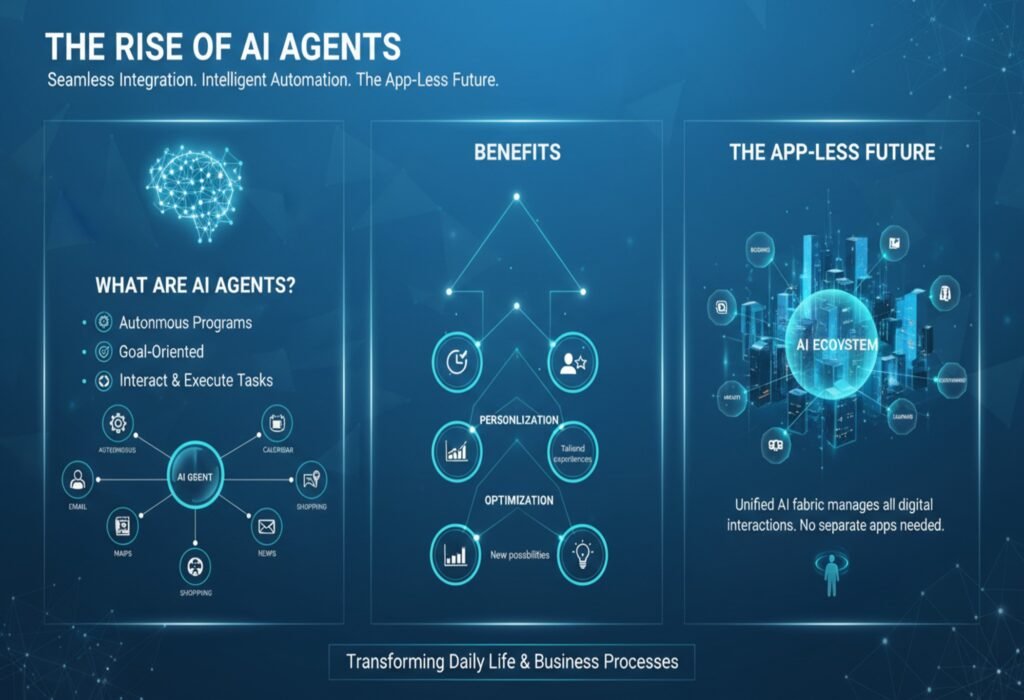
The technological landscape is undergoing a significant transformation, with AI Agents at the forefront of this change. As we move deeper into 2026, the rise of AI agents is reshaping how we interact with technology, potentially leading to the disappearance of traditional mobile applications. This blog will explore the mechanics of AI agents, their benefits, and the impact they may have on the future of apps.
Introduction to AI Agents
AI agents represent a new frontier in technology, capable of performing tasks autonomously and assisting users in a more interactive way. They leverage advanced algorithms and machine learning to understand user preferences, providing personalized experiences. Businesses utilizing AI technology advancements gain a competitive edge by enhancing customer engagement and streamlining operations.
Recent insights suggest that the demand for AI agents is expected to surge as more companies recognize their potential. In 2026, the integration of AI agents into everyday applications may become commonplace, making them integral to both personal and professional environments.
Understanding AI Agent Technology
AI agent technology encompasses various frameworks, including natural language processing (NLP) and machine learning. These technologies enable agents to interpret user commands and execute tasks effectively. For instance, virtual assistants like Siri and Google Assistant are examples of basic AI agents that can perform specific tasks based on voice commands.
The Role of AI-Powered Assistants
AI-powered assistants are designed to enhance user productivity by automating routine tasks. They can manage schedules, send reminders, and even control smart home devices. As these assistants evolve, they are expected to handle more complex requests and provide contextual information, making them indispensable tools for users.
What Are AI Agents?
AI agents are software applications that utilize artificial intelligence to perform tasks independently or with minimal human intervention. They can analyze data, learn from interactions, and adapt their responses based on user behavior. This adaptability makes them versatile for a variety of applications, from customer service to personal assistance.
Businesses using future of AI applications can streamline processes, reduce operational costs, and enhance customer satisfaction. As AI agents become more sophisticated, they are likely to take on roles traditionally filled by human employees, particularly in repetitive or data-driven tasks.
Generative AI Tools and Smart Automation
Generative AI tools are a subset of AI agents that can create content, from text to images. These tools are becoming increasingly popular in marketing and content creation, allowing businesses to generate high-quality materials quickly. Smart automation, powered by AI agents, can optimize workflows and improve efficiency across various industries.
Trends Shaping AI in 2026
As we look ahead, several trends are emerging in the AI landscape. Increased investment in AI technologies, advancements in machine learning algorithms, and a growing emphasis on ethical AI practices are shaping the future. In 2026, we can expect AI agents to become more intuitive, user-friendly, and capable of handling a wider range of tasks.
How AI Agents Work
AI agents operate through a combination of data processing, machine learning, and user interaction. When a user inputs a command, the agent analyzes the request, retrieves relevant data, and generates a response. This process involves several steps, including understanding context, evaluating options, and executing tasks.
Businesses using benefits of AI agents can expect improved efficiency and reduced error rates. As these agents learn from user interactions, they become more adept at providing accurate responses and suggestions.
The Learning Process of AI Agents
AI agents utilize various learning techniques, including supervised and unsupervised learning. In supervised learning, the agent is trained on labeled data, allowing it to make predictions based on input. Unsupervised learning, on the other hand, enables the agent to identify patterns and relationships within data without prior labels.
User Interaction and Feedback
User feedback plays a crucial role in the effectiveness of AI agents. By analyzing user interactions, agents can refine their algorithms and improve their performance. This feedback loop is essential for creating a more personalized experience, as agents adapt to individual preferences over time.
Difference Between AI Agents and Traditional Apps
The primary distinction between AI agents and traditional apps lies in their functionality. While traditional apps require user input for every action, AI agents can operate autonomously, anticipating user needs and executing tasks proactively. This shift towards an app-less future is driven by the desire for more seamless and efficient interactions.
Businesses using challenges in AI development must navigate issues such as data privacy, security, and ethical considerations. As AI agents gain prominence, addressing these challenges will be crucial for their widespread adoption.
User Experience and Engagement
AI agents enhance user experience by providing more intuitive interactions. Unlike traditional apps that often require users to navigate through multiple screens, AI agents can streamline processes, allowing users to achieve their goals with minimal effort. This increased engagement can lead to higher satisfaction and loyalty among users.
Integration with Existing Technologies
AI agents are designed to integrate with various technologies and platforms, making them versatile tools for businesses. They can connect with CRM systems, e-commerce platforms, and other software solutions, enhancing overall functionality. This integration is vital for creating a cohesive ecosystem where AI agents can thrive.
Why Big Tech Companies Are Investing in AI Agents
Big tech companies like Google, Microsoft, and Apple are heavily investing in AI agents due to their potential to revolutionize user interactions. As consumer expectations evolve, these companies recognize the need to adapt and innovate. By developing advanced AI agents, they aim to enhance their product offerings and maintain a competitive edge.
Businesses using trends in AI for businesses can capitalize on these developments by implementing their own AI solutions. This not only improves operational efficiency but also positions them as leaders in their respective industries.
The Competitive Landscape
The race to develop the most advanced AI agents is intensifying among tech giants. Companies are investing in research and development to create more sophisticated algorithms and improve user experiences. As this competition heats up, we can expect rapid advancements in AI technology.
Market Demand for AI Solutions
The increasing demand for AI solutions across various sectors is driving investments in AI agents. Businesses are looking for ways to enhance efficiency, reduce costs, and improve customer experiences. AI agents provide a solution to these challenges, making them an attractive option for companies seeking to innovate.
Real-World Examples of AI Agents
Several companies are leading the way in the development of AI agents. OpenAI’s ChatGPT, for example, has gained significant attention for its ability to generate human-like text and engage in meaningful conversations. Similarly, Google’s Assistant and Amazon’s Alexa have become staple AI agents in many households.
These examples illustrate the diverse applications of AI agents, from personal assistants to customer service representatives. As these technologies continue to evolve, we can expect even more innovative use cases to emerge.
Case Study: OpenAI’s ChatGPT
OpenAI’s ChatGPT has revolutionized how users interact with AI. By providing contextually relevant responses, it enhances user engagement and satisfaction. This model showcases the potential of AI agents to transform traditional communication methods.
Case Study: Google Assistant
Google Assistant exemplifies the capabilities of AI agents in managing daily tasks. From setting reminders to controlling smart home devices, it streamlines user experiences and demonstrates the practical benefits of AI technology.
Could Mobile Apps Disappear in the Future?
The rise of AI agents raises the question of whether traditional mobile apps could become obsolete. While it may seem far-fetched, the trend towards an app-less future is gaining traction. As AI agents become more capable, they may replace the need for standalone applications.
Businesses should consider the implications of this shift and explore how they can adapt their strategies to incorporate AI agents effectively. The transition may not happen overnight, but the groundwork is being laid for a future where AI agents dominate.
The Evolution of User Expectations
As users become more accustomed to AI agents, their expectations will evolve. They will seek more personalized and efficient interactions, pushing businesses to innovate continuously. This shift may lead to a decline in traditional app usage as users gravitate towards AI-driven solutions.
The Role of Developers
Developers will need to adapt their skills and approaches to meet the demands of an AI-driven landscape. As AI agents gain prominence, the focus will shift from creating standalone apps to developing intelligent systems that can learn and adapt over time.
Benefits of an App-less AI Ecosystem
An app-less ecosystem powered by AI agents offers several advantages. Users can enjoy seamless interactions without the need to download multiple applications. This streamlined approach can lead to increased efficiency and reduced friction in user experiences.
Enhanced User Experience
AI agents can provide a more intuitive and engaging user experience compared to traditional apps. By anticipating user needs and offering personalized recommendations, they can create a more satisfying interaction.
Cost Savings for Businesses
For businesses, an app-less approach can result in significant cost savings. By reducing the need for app development and maintenance, companies can allocate resources more efficiently. This shift allows them to focus on enhancing their AI capabilities and improving customer experiences.
Risks and Challenges of AI Agents
Despite the numerous benefits of AI agents, challenges remain. Issues such as data privacy, security, and ethical considerations must be addressed to ensure the responsible development and deployment of AI technologies.
Data Privacy Concerns
As AI agents collect and analyze user data, concerns about privacy and security arise. Businesses must implement robust measures to protect user information and comply with regulations to build trust with their customers.
Ethical Considerations
The ethical implications of AI agents are a growing concern. As these technologies become more autonomous, questions about accountability and decision-making arise. Businesses must navigate these challenges to ensure responsible AI usage.
Future Predictions for AI Agents in 2026 and Beyond
Looking ahead, the future of AI agents appears promising. As technology continues to evolve, we can expect AI agents to become even more sophisticated and capable. By 2026, they may play a central role in our daily lives, transforming how we interact with technology.
Increased Integration with Everyday Life
AI agents are likely to become more integrated into our daily routines, assisting with tasks ranging from scheduling to shopping. This increased integration will enhance user experiences and drive further adoption.
The Emergence of New Use Cases
As AI technology advances, new use cases for AI agents will emerge. From healthcare to education, the potential applications are vast, offering exciting opportunities for innovation.
Conclusion
The rise of AI Agents signifies a transformative shift in technology. As we approach 2026, these intelligent systems are poised to replace traditional mobile apps, offering enhanced user experiences and increased efficiency. Businesses must adapt to this changing landscape by embracing AI agents and exploring their potential benefits. The future is bright for AI agents, and their impact will be felt across various sectors, paving the way for a more innovative and automated world.