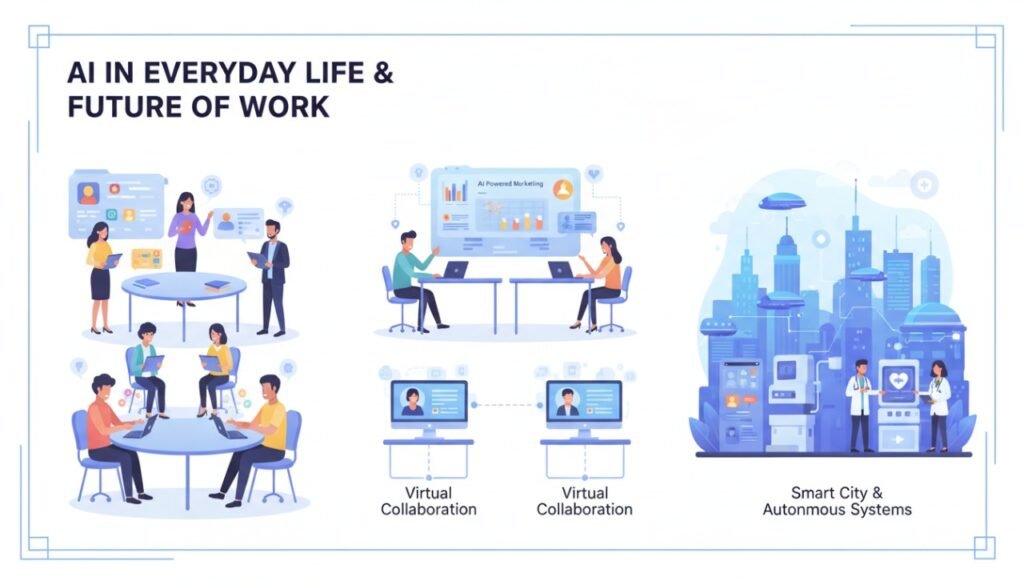
AI in everyday life and the future of work represent two intertwined trajectories shaping modern society. Artificial intelligence (AI) refers to intelligent machines designed to simulate human cognition and perform tasks such as learning, problem-solving, and adaptation. In everyday life, AI facilitates convenience, efficiency, and enhanced decision-making in ways that are increasingly seamless and invisible. This blog explores how AI in everyday life is revolutionizing our personal experiences and reshaping workplaces, setting the stage for future innovations.
AI in Everyday Life & Future of Work Technology & Core Principles
At its core, AI consists of algorithms and models that analyze data, recognize patterns, and make autonomous decisions. The technology relies on multiple components working in concert to deliver continuous improvement and tailored solutions.
Key components of AI in everyday life and work include:
Machine Learning (ML): Algorithms that learn from historical data to predict outcomes and automate decisions.
Natural Language Processing (NLP): Enables machines to understand, interpret, and generate human language.
Computer Vision: Allows interpretation of visual inputs from cameras or sensors.
Robotic Process Automation (RPA): Automates repetitive digital tasks, enhancing efficiency.
Sensor Networks & IoT Integration: Connect everyday devices to collect and analyze data for intelligent responses.
Data Analytics: Extracts actionable insights to personalize and optimize experiences.
These components together enable AI systems to learn from interactions, improve over time, and integrate smoothly into diverse aspects of life and work.
Real-World Applications of AI in Everyday Life
Example 1: Healthcare – Personalized Patient Monitoring
In healthcare, AI-powered devices monitor patient vitals and predict potential health issues proactively.
Context: A hospital leveraging AI to track patient vitals continuously.
Workflow: AI algorithms analyze sensor data for early warning signs and alert medical staff.
Results: Improved response times and personalized care, reducing complications.
Example 2: Retail – Smart Shopping Assistants
Retailers use AI to enhance customer shopping experiences through personalized recommendations.
Context: An online store employing AI chatbots to guide customer choices.
Workflow: AI analyzes past purchases and browsing habits to suggest relevant products.
Results: Increased customer satisfaction and higher sales conversions.
Example 3: Manufacturing – Predictive Maintenance
Manufacturers implement AI systems to predict equipment failures before they occur.
Context: A factory integrating AI sensors on machinery.
Workflow: AI models analyze operational data to schedule maintenance proactively.
Results: Reduced downtime and optimized production efficiency.
Benefits of AI in Everyday Life
Enhanced productivity by automating routine and repetitive tasks.
Personalized experiences across healthcare, retail, and entertainment.
Faster and better decision-making grounded in data analytics.
Improved safety through predictive monitoring and alerts.
Greater accessibility via AI-enabled assistants and adaptive technologies.
Challenges & Limitations
Despite its potential, AI in everyday life faces significant hurdles:
Privacy Concerns: Collecting and analyzing personal data can risk individual privacy.
Bias and Fairness: AI models may perpetuate biases present in training data.
Transparency: Complex AI algorithms sometimes lack explainability.
Dependence: Over-reliance on AI might erode human skills.
Infrastructure Costs: Implementing AI systems requires investment and maintenance.
Addressing these challenges is critical to harnessing AI’s benefits responsibly.
Future Trends & Innovation in AI in Everyday Life
Looking ahead, AI will deepen its integration into daily routines and the workplace through:
Edge AI: Deploying AI processing closer to data sources for real-time intelligence.
Human-AI Collaboration: Augmentation tools that empower workers rather than replace them.
Ethical AI Frameworks: Ensuring fairness, accountability, and transparency are standard.
AI-Driven Remote Work Tools: Enhanced virtual collaboration and productivity platforms.
Smart Environments: Homes and offices adapting dynamically to occupants’ needs.
These innovations promise a future where AI acts as a seamless partner in everyday endeavors.