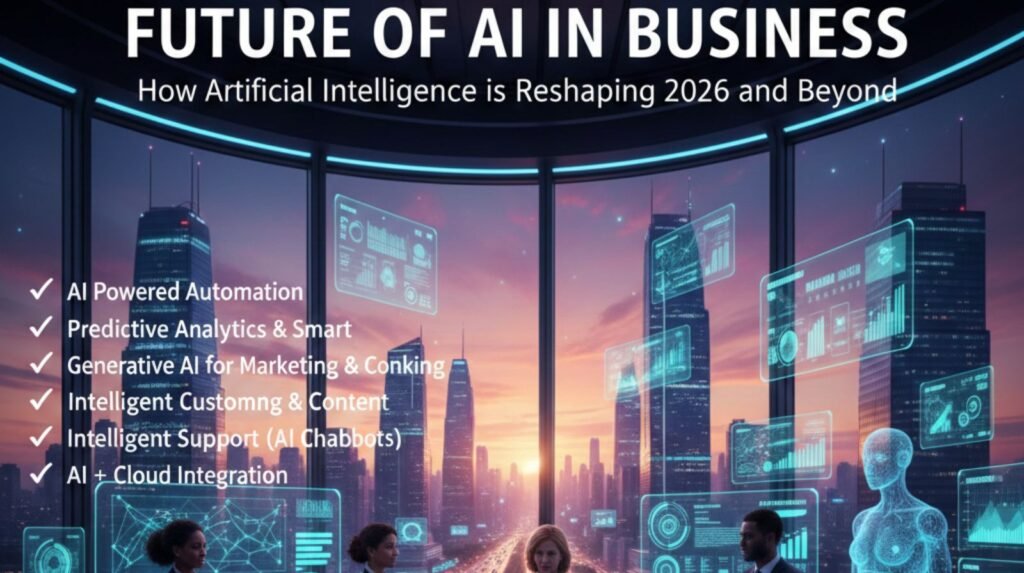
The Future of AI in Business & Daily Life is no longer a distant concept confined to science fiction—it’s happening now, transforming how we work, communicate, shop, and solve problems. As we navigate through 2026, artificial intelligence has evolved from experimental technology into an indispensable tool that powers everything from personalized shopping experiences to predictive healthcare diagnostics. Understanding the trajectory of AI in daily life and its expanding role across industries is essential for students preparing for tomorrow’s careers, professionals seeking competitive advantages, and businesses aiming to thrive in an increasingly automated world.
The Current State of Artificial Intelligence in 2026
The future of artificial intelligence 2026 has materialized into tangible applications that touch nearly every aspect of modern existence. Unlike the early days of AI when machine learning was primarily confined to tech giants, today’s landscape features democratized access to powerful AI tools for productivity that small businesses and individual professionals can leverage.
In India specifically, AI adoption has accelerated dramatically. Companies like Tata Consultancy Services and Infosys have integrated AI-driven solutions for client projects, while startups such as Haptik and Vernacular.ai are revolutionizing customer service through conversational AI platforms that understand regional languages and cultural nuances.
AI Applications in Business: Transforming Industries from the Ground Up
How AI is Changing Industries Across Sectors
The impact of how AI in Business is changing industries manifests differently across various sectors, creating unprecedented efficiency gains and entirely new business models.
Manufacturing and Supply Chain
Indian manufacturing giants like Mahindra & Mahindra have deployed AI-powered predictive maintenance systems that analyze equipment data in real-time, reducing downtime by up to 40%. These systems predict failures before they occur, saving millions in repair costs and lost production time.
Healthcare and Diagnostics
AI applications in business have revolutionized healthcare delivery. Apollo Hospitals uses AI algorithms to analyze medical imaging, detecting early-stage cancers with accuracy rates exceeding 95%. Telemedicine platforms powered by AI triage systems now serve rural areas across India, bridging the healthcare accessibility gap.
Financial Services and Banking
HDFC Bank and ICICI Bank leverage AI for fraud detection, analyzing thousands of transactions per second to identify suspicious patterns. Chatbots handle routine customer queries, freeing human agents to address complex financial planning needs.
Retail and E-commerce
Flipkart and Amazon India utilize AI recommendation engines that personalize shopping experiences for millions of users, increasing conversion rates by analyzing browsing behavior, purchase history, and contextual factors like regional festivals and seasonal preferences.
AI Automation Benefits: Quantifiable Business Impact
The AI automation benefits extend far beyond cost reduction:
- Enhanced Decision-Making: AI analyzes vast datasets to uncover insights humans might miss, enabling data-driven strategies
- 24/7 Operational Capacity: Automated systems work continuously without fatigue, dramatically improving service availability
- Scalability: AI solutions scale effortlessly as business demands grow, without proportional increases in operational costs
- Error Reduction: Automated processes minimize human errors in repetitive tasks, improving accuracy in accounting, inventory management, and quality control
- Customer Experience Optimization: AI-powered personalization creates tailored experiences that boost satisfaction and loyalty
AI in Daily Life: The Personal Revolution
Real-World AI Examples Shaping Everyday Experiences
The integration of AI in daily life has become so seamless that many users interact with dozens of AI systems daily without conscious awareness.
Smart Home Management
Voice assistants like Alexa and Google Assistant now control lighting, temperature, security systems, and appliances in Indian homes. These systems learn household patterns, automatically adjusting settings based on occupancy, time of day, and user preferences.
Personalized Education
Platforms like BYJU’S and Unacademy use AI to create customized learning paths for students, identifying knowledge gaps and adapting content difficulty based on individual progress. This personalized approach has shown measurably improved learning outcomes compared to traditional one-size-fits-all methods.
Transportation and Navigation
Google Maps and Ola leverage AI to predict traffic patterns, suggest optimal routes, and estimate arrival times with remarkable accuracy. AI algorithms process real-time data from millions of users to provide continuously updated recommendations.
Content Consumption
Netflix, Spotify, and YouTube employ sophisticated AI recommendation systems that curate personalized content libraries, keeping users engaged by predicting preferences based on viewing and listening history.
Healthcare Monitoring
Wearable devices like the Apple Watch and Fitbit use AI to monitor heart rate variability, sleep patterns, and physical activity, alerting users to potential health concerns and encouraging healthier lifestyle choices.
AI Tools for Productivity: Empowering Professionals
Modern professionals rely on an expanding ecosystem of AI tools for productivity:
Writing and Communication: Tools like Grammarly and QuillBot enhance writing quality, while AI meeting assistants like Otter.ai transcribe and summarize discussions automatically.
Project Management: Platforms like Asana and Monday.com incorporate AI features that predict project timelines, identify bottlenecks, and suggest resource allocation improvements.
Data Analysis: Business intelligence tools like Tableau and Power BI use AI to automatically detect trends, anomalies, and actionable insights from complex datasets.
Creative Work: AI-powered design tools like Canva’s Magic Design and Adobe’s Sensei accelerate creative workflows, generating layout suggestions and automating repetitive design tasks.
Preparing for the Future: Actionable Strategies
For Students
- Develop AI Literacy: Understanding fundamental AI in Business concepts, even without deep technical expertise, will be crucial across all career paths
- Focus on Complementary Skills: Cultivate uniquely human abilities like creative problem-solving, emotional intelligence, and ethical reasoning that AI cannot easily replicate
- Experiment with AI Tools: Gain hands-on experience with accessible AI platforms to understand their capabilities and limitations
- Stay Adaptable: The AI landscape evolves rapidly; continuous learning and flexibility will be essential career survival skills
For Professionals
- Identify Automation Opportunities: Assess which aspects of your current role could benefit from AI augmentation to increase efficiency
- Upskill Strategically: Pursue training in AI-adjacent areas relevant to your field, whether that’s data interpretation, prompt engineering, or AI ethics
- Embrace Collaboration: View AI as a collaborative tool that enhances human capabilities rather than a replacement threat
- Lead with Ethics: Advocate for responsible AI implementation that considers privacy, bias, and transparency concerns
For Businesses
- Start with High-Impact Use Cases: Identify specific business challenges where AI can deliver measurable returns on investment
- Invest in Data Infrastructure: Quality AI outputs depend on quality data inputs; prioritize data collection, cleaning, and management systems
- Cultivate AI Talent: Build internal expertise through hiring, training, and partnerships with AI specialists and academic institutions
- Establish Governance Frameworks: Develop clear policies addressing AI ethics, data privacy, algorithmic transparency, and accountability
Challenges and Ethical Considerations
The Future of AI in Business & Daily Life isn’t without concerns. Job displacement in certain sectors, algorithmic bias perpetuating existing inequalities, privacy vulnerabilities from extensive data collection, and the environmental impact of energy-intensive AI systems all require thoughtful addressal.
Progressive organizations are implementing ethical AI frameworks that prioritize fairness, transparency, and human oversight. India’s proposed Digital Personal Data Protection Act represents governmental efforts to establish guardrails ensuring AI development serves public interest while enabling innovation.
Conclusion: Embracing the AI-Powered Tomorrow
The Future of AI in Business & Daily Life represents one of the most significant technological transformations in human history. From revolutionizing business operations through intelligent automation to enhancing daily experiences with personalized digital assistants, AI’s influence will only deepen in the coming years. The future of artificial intelligence 2026 demonstrates that we’re past the question of whether AI will reshape society—we’re now determining how thoughtfully and equitably we’ll navigate this transformation.
Success in this AI-driven era requires proactive engagement rather than passive observation. Whether you’re a student mapping career trajectories, a professional seeking competitive advantages, or a business leader driving organizational strategy, understanding and leveraging AI applications in business and everyday life is no longer optional—it’s imperative.
Take action today: Identify one area of your work or life where AI tools could create meaningful improvement, experiment with available solutions, and commit to ongoing learning about this rapidly evolving field. The future belongs to those who thoughtfully integrate AI’s capabilities while preserving the irreplaceable value of human creativity, empathy, and judgment.