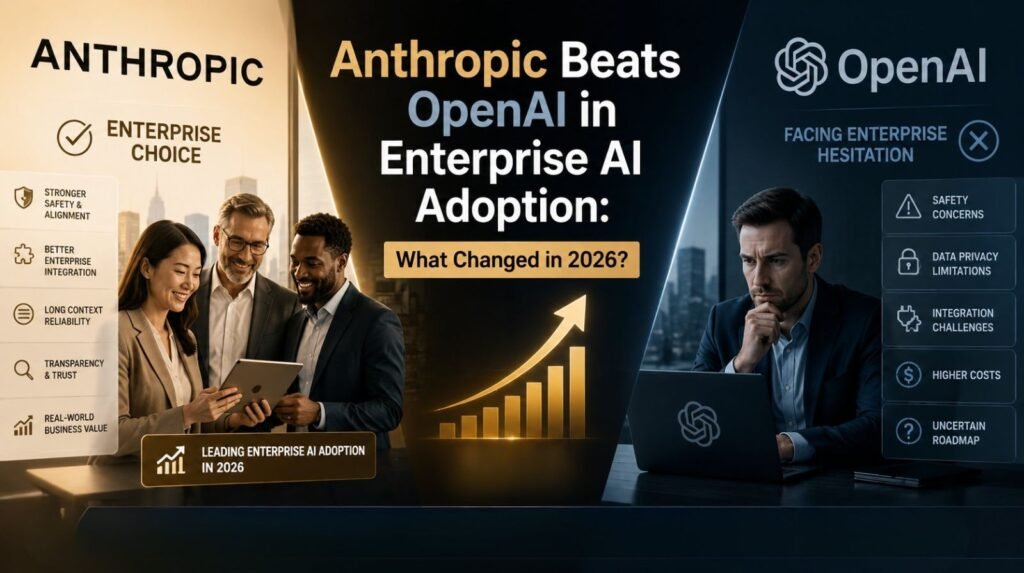
In 2026, the landscape of enterprise AI has shifted dramatically, with Anthropic Beats OpenAI in Enterprise AI Adoption becoming a notable trend. As businesses increasingly seek advanced AI solutions, Anthropic’s Claude AI has emerged as a preferred choice over OpenAI’s offerings. This article explores the factors driving this change, providing insights into the comparative features, industry adoption, and future trends in enterprise AI.
Why Enterprises Are Choosing Anthropic in 2026
The decision for enterprises to adopt Anthropic’s Claude AI over OpenAI solutions is influenced by several key factors
Enhanced Performance and Reliability
Many businesses report that Claude AI delivers superior performance in natural language understanding and generation. This reliability is crucial for enterprises that depend on AI for customer interactions, data analysis, and decision-making processes. In 2026, companies have highlighted a marked improvement in Claude AI’s ability to handle complex queries and provide contextually relevant responses
Improved Safety and Compliance
Safety and compliance are paramount for enterprises, especially in regulated industries. Anthropic has focused on creating AI systems that prioritize ethical guidelines and user safety. This commitment has made Claude AI a more attractive option for businesses wary of the potential risks associated with AI deployment. In 2026, many enterprises have noted that Claude AI’s design minimizes biases and ensures adherence to legal standards, making it a safer choice.
Cost-Effectiveness
Cost considerations play a significant role in AI adoption. Businesses have observed that implementing Claude AI often results in lower operational costs compared to OpenAI solutions. This cost-effectiveness, combined with the enhanced capabilities of Claude AI, has led to a surge in its adoption across various sectors.
Claude AI vs OpenAI: Feature Comparison
A direct comparison between Claude AI and OpenAI reveals distinct differences that influence enterprise decisions.
Natural Language Processing Capabilities
Claude AI has made significant strides in natural language processing (NLP). Its ability to understand context and nuance allows for more accurate and human-like interactions. Enterprises utilizing Claude AI report higher customer satisfaction rates due to improved communication.
Integration with Existing Systems
Another advantage of Claude AI is its seamless integration with existing enterprise systems. Many businesses have found that Claude AI can be easily incorporated into their workflows without extensive modifications. This ease of integration contrasts with some challenges faced when implementing OpenAI solutions.
Customization and Scalability
Customization is crucial for enterprises with unique needs. Claude AI offers more flexible customization options, allowing businesses to tailor the AI to their specific requirements. Furthermore, its scalability ensures that as businesses grow, their AI capabilities can expand accordingly.
Industries Driving Anthropic Adoption
In 2026, several industries have emerged as leaders in adopting Claude AI, demonstrating its versatility and effectiveness.
Financial Services
The financial sector has been quick to embrace Claude AI for its ability to analyze large datasets and generate insights. Financial institutions utilize Claude AI for risk assessment, fraud detection, and customer service automation. This trend is expected to continue as the demand for data-driven decision-making grows.
Healthcare
Healthcare providers are increasingly turning to Claude AI for its potential to enhance patient care. From managing patient records to providing virtual assistance, Claude AI is helping healthcare professionals streamline operations and improve outcomes. The ability to process and analyze medical data efficiently has made it a valuable asset in this industry.
Retail and E-commerce
Retailers and e-commerce platforms are leveraging Claude AI to personalize customer experiences. By analyzing consumer behavior and preferences, businesses can offer tailored recommendations, driving sales and customer loyalty. The shift towards personalized shopping experiences has fueled the adoption of Claude AI in this sector.
Enterprise AI Trends in 2026
The landscape of Anthropic Beats OpenAI is evolving, with several key trends shaping its future.
Rise of Generative AI
Generative AI is becoming a cornerstone of enterprise applications. In 2026, businesses are increasingly using AI to generate content, design products, and even create marketing strategies. This trend highlights the growing reliance on AI for creativity and innovation.
Focus on Ethical AI
Ethical considerations are at the forefront of AI development. Companies are prioritizing transparent and accountable AI systems that align with societal values. This focus on ethical AI is driving enterprises to choose solutions like Claude AI, which emphasize safety and compliance.
Automation of Business Processes
Automation continues to be a major trend in enterprise AI. Businesses are adopting AI tools to automate repetitive tasks, allowing employees to focus on higher-value activities. This shift towards automation is enhancing productivity and efficiency across various sectors.
Challenges OpenAI Faces in Enterprise Markets
Despite its popularity, OpenAI is encountering challenges that hinder its growth in the enterprise market.
Perception of Complexity
Many enterprises perceive OpenAI solutions as complex and difficult to implement. This perception can deter potential users who are looking for straightforward and user-friendly AI tools. In contrast, Claude AI’s reputation for ease of use has made it a more appealing option.
Concerns Over Data Privacy
Data privacy remains a significant concern for enterprises. OpenAI has faced scrutiny regarding its data handling practices, leading some businesses to hesitate in adopting its solutions. Claude AI’s emphasis on secure data management has positioned it favorably in comparison.
Competitive Pressure
The competitive landscape is intensifying, with numerous AI providers emerging. OpenAI faces increasing pressure from not only Anthropic but also other players in the market. This competition is prompting OpenAI to innovate rapidly, which may not always align with enterprise needs.
Future of Enterprise AI Competition
Looking ahead, the competition between Anthropic and OpenAI is expected to evolve.
Collaborations and Partnerships
As enterprises seek comprehensive AI solutions, collaborations between AI providers and industry leaders may become more common. Such partnerships can enhance the capabilities of AI tools, making them more attractive to businesses.
Continuous Innovation
Both Anthropic and OpenAI will need to focus on continuous innovation to remain relevant. The rapid pace of technological advancement means that staying ahead of the curve is essential for any AI provider. Enterprises will benefit from this innovation as AI solutions become more sophisticated and effective.
Increased Investment in AI Research
The future of enterprise AI will likely see increased investment in research and development. Companies are recognizing the value of AI and are willing to allocate resources to enhance their capabilities. This investment will drive the next generation of AI tools, further shaping the competitive landscape.
Conclusion
In 2026, the shift towards Anthropic Beats OpenAI in Enterprise AI Adoption is evident as businesses prioritize performance, safety, and cost-effectiveness. With Claude AI leading the charge, enterprises across various industries are embracing its capabilities to drive innovation and efficiency. As the competition between AI providers intensifies, the future of enterprise AI looks promising, with ongoing advancements that will continue to transform how businesses operate.